
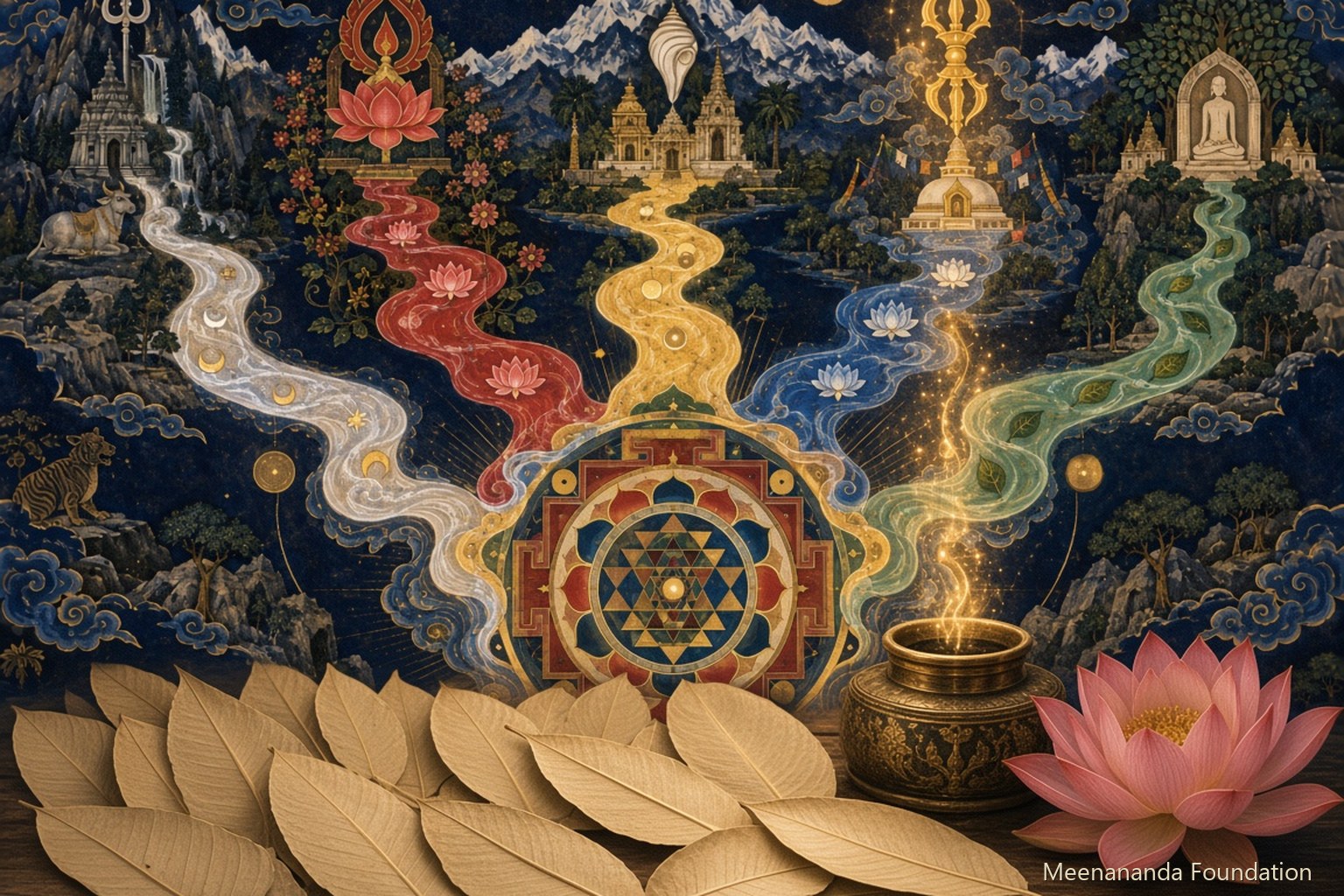
Gujhya Gyan
Glossary
Plain-language definitions of recurring Sanskrit and study terms.
- Ācāra
- conduct, observance or mode of practice; classification varies by text.
- Āgama
- “that which has come down”; a revealed scripture or scriptural class, especially in Śaiva, Śākta and Vaiṣṇava settings.
- Āmnāya
- transmission, sacred current or directional revelation; often used in lineage-specific schemes.
- Bhairava
- a formidable and transcendent form/name of Śiva central to several tantric traditions.
- Bhakti
- devotion, loving participation or relationship with the divine.
- Bīja
- “seed”; a condensed mantra syllable associated with a deity or power. Many uses are initiation-specific.
- Cakra
- wheel, circle or center; in subtle-body maps, one of several possible lotus-like centers. Systems vary.
- Darśana
- seeing and being seen by the sacred; also a philosophical viewpoint or system.
- Devī
- Goddess; “the shining/divine one.”
- Dīkṣā
- initiation or consecration that authorizes and transforms a practitioner's relationship to a path.
- Guru
- a teacher of spiritual weight or authority; the role does not remove ethical accountability.
- Guhya
- hidden, secret, inward, protected or esoteric.
- Jñāna
- knowledge, insight or liberating understanding.
- Kaula
- a wide family of tantric currents associated with *kula* (“family,” “totality,” “embodied group”), interpreted differently across sources.
- Kālīkula
- families of Goddess traditions centered on Kālī and related forms.
- Kuṇḍalinī
- “coiled one”; a transformative power described differently in yogic and tantric systems.
- Maṇḍala
- a structured sacred field, circle, domain or diagram used in ritual and contemplation.
- Mantra
- a consecrated sound-form, syllable, name, phrase or verse used within a defined tradition.
- Mudrā
- seal, gesture or embodied configuration; meaning depends on artistic and ritual context.
- Nāḍī
- channel in subtle-body maps; not identical with a nerve or blood vessel.
- Nyāsa
- ritual “placing” or installation, often of mantra or deity aspects in the body; detailed sequences may be restricted.
- Pāñcarātra
- a major Vaiṣṇava scriptural and ritual tradition associated with Nārāyaṇa/Vāsudeva worship.
- Prāṇa
- life-breath or vital process; meanings extend beyond ordinary respiration.
- Pratyabhijñā
- recognition; especially associated with nondual Śaiva philosophy of recognizing consciousness's universal nature.
- Pūjā
- worship through offerings, attention and hospitality to divine presence.
- Purāṇa
- a broad class of Sanskrit narrative and religious texts involving cosmology, genealogy, sacred places, deities and devotion.
- Sādhana
- disciplined practice oriented toward realization or a religious goal.
- Sampradāya
- transmitted religious community, teaching lineage or tradition.
- Śaiva
- related to Śiva or Śaiva traditions.
- Śākta
- related to Śakti/Devī or Goddess traditions.
- Śakti
- power, capacity or divine energy; also the Goddess as ultimate reality in Śākta traditions.
- Śrīcakra
- sacred diagram central to Śrīvidyā; not generic decorative geometry.
- Śrīkula
- Goddess traditions oriented toward Śrī/Tripurasundarī, commonly contrasted with Kālīkula in broad classifications.
- Siddhi
- accomplishment, perfection or extraordinary capacity; pursuit of powers is ethically and spiritually contested.
- Tantra
- depending on context, a scripture, system, doctrine or the broad family of traditions discussed in this collection.
- Tattva
- principle, reality-category or constituent used to map manifestation and experience.
- Upaniṣad
- a diverse body of texts concerned with ultimate reality, self, knowledge, death, ritual interiorization, devotion and later yogic ideas. There is no single count: a traditional list names 108; a principal (mukhya) group of about ten to thirteen is most often studied.
- Vajrayāna
- “Diamond/Thunderbolt Vehicle”; a broad name for tantric Buddhist paths, internally diverse.
- Veda
- the ancient, layered Sanskrit revelation. There are four Vedas: Ṛgveda, Yajurveda, Sāmaveda and Atharvaveda, each with associated Saṃhitā, Brāhmaṇa, Āraṇyaka and Upaniṣad strata.
- Yantra
- instrument or sacred diagram whose identity belongs to a specific deity, text and use.