
Gujhya Gyan
How Many Streams of Tantra?
Why no single number is authoritative, and four useful ways to map tantric diversity.
There is no universally accepted number of tantric streams. A count changes according to whether we classify by religious community, deity, scripture, lineage, geography, ritual orientation or philosophical school. Claims such as “there are exactly three” or “exactly sixty-four” usually belong to a particular symbolic or textual scheme, not to a neutral census of all Tantra.
Map one: large religious families
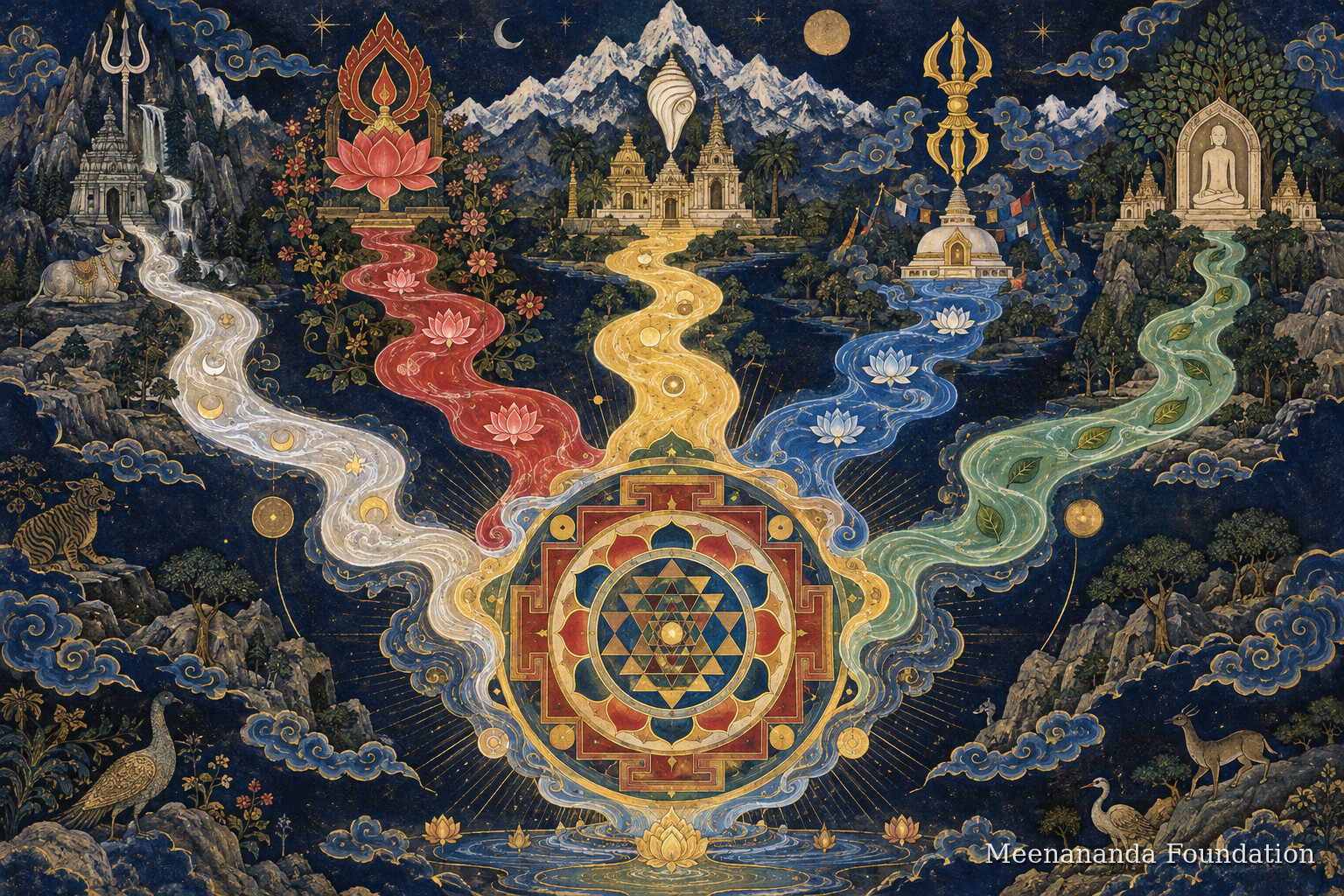
A broad introductory map identifies five families:
- Śaiva traditions, centered on Śiva and forms of Śaiva revelation;
- Śākta traditions, centered on Devī/Śakti and goddess-oriented scriptures;
- Vaiṣṇava tantric or Āgamic traditions, especially Pāñcarātra and related ritual worlds;
- Buddhist tantric traditions, later organized in several systems and vehicles;
- Jain tantric currents, where mantra, diagram, protective deity and ritual materials developed within Jain commitments.
This fivefold map is useful but coarse. It should never imply that all five share one theology, initiation or goal.
Map two: currents within Hindu Tantra
Within Śaiva and Śākta worlds, sources and scholars describe many further formations: Śaiva Siddhānta; nondual Bhairava-oriented systems; Kaula and Trika currents; Krama; goddess-centered Vidyāpīṭha traditions; Śrīvidyā; Kālīkula; Kubjikā traditions; regional temple and household lineages. These labels overlap historically. A tradition may inherit scripture from one current, ritual from another, and later commentary from a third.
The familiar pairing Dakṣiṇācāra (“right-hand” observance) and Vāmācāra (“left-hand” observance) concerns styles of ritual and interpretation in some contexts; it is not a complete map of Tantra. Likewise, lists of five āmnāyas (transmissions/directions), ten Mahāvidyās, or sixty-four tantras/yoginīs are meaningful within particular symbolic worlds but not universal denominators.
Map three: geography and language
Tantric traditions developed through regional networks: Kashmir and the northwest; the Himalayan and Nepalese manuscript world; Bengal and Assam; Odisha; Tamil, Kannada and Telugu regions; Kerala; Tibet; and Southeast Asia. Geography matters because deity forms, temple institutions, manuscripts, vernacular poetry and social history differ. “Bengal Tantra” is itself plural: Kālī and Tārā devotion, Śākta textual systems, temple cultures, household practice, Baul and Sahajiyā interactions, and modern reform cannot be reduced to one line.
Map four: orientation of practice
Another map follows emphasis rather than denomination:
- temple installation and public liturgy;
- household worship;
- mantra and visualization;
- yogic and subtle-body cultivation;
- philosophical recognition or nondual contemplation;
- protection, healing or royal power;
- cremation-ground and ascetic practice;
- devotional surrender.
One lineage may combine several orientations. The map describes what practitioners do and value; it does not tell us their complete identity.
The “three streams” answer
If a reader needs the shortest Hindu introduction, one can say that tantric materials are often grouped broadly as Śaiva, Śākta and Vaiṣṇava. That answer is useful only if immediately followed by two cautions: Buddhist and Jain tantras also exist, and each of the three Hindu headings contains extensive diversity.
Unity without flattening
The image of rivers meeting an ocean is attractive, but it can flatten genuine differences. Some systems teach an enduring self; Buddhist systems generally reject such a self. Some worship a supreme Goddess; others interpret deities through distinct frameworks. Comparative study should make conversation possible without pretending every tradition says the same thing.
The best answer to “how many?” is therefore: many, depending on the map. The mature next question is: which map helps us understand this text, image, place or lineage?