
গুহ্য জ্ঞান
Śiva, Śakti and Ardhanārīśvara
The inseparability of awareness and power, contemplated through the composite form of Śiva and Pārvatī.
অধ্যায়গুলি প্রথমে ইংরেজিতে প্রকাশিত। বাংলা অনুবাদ পরে আসবে।
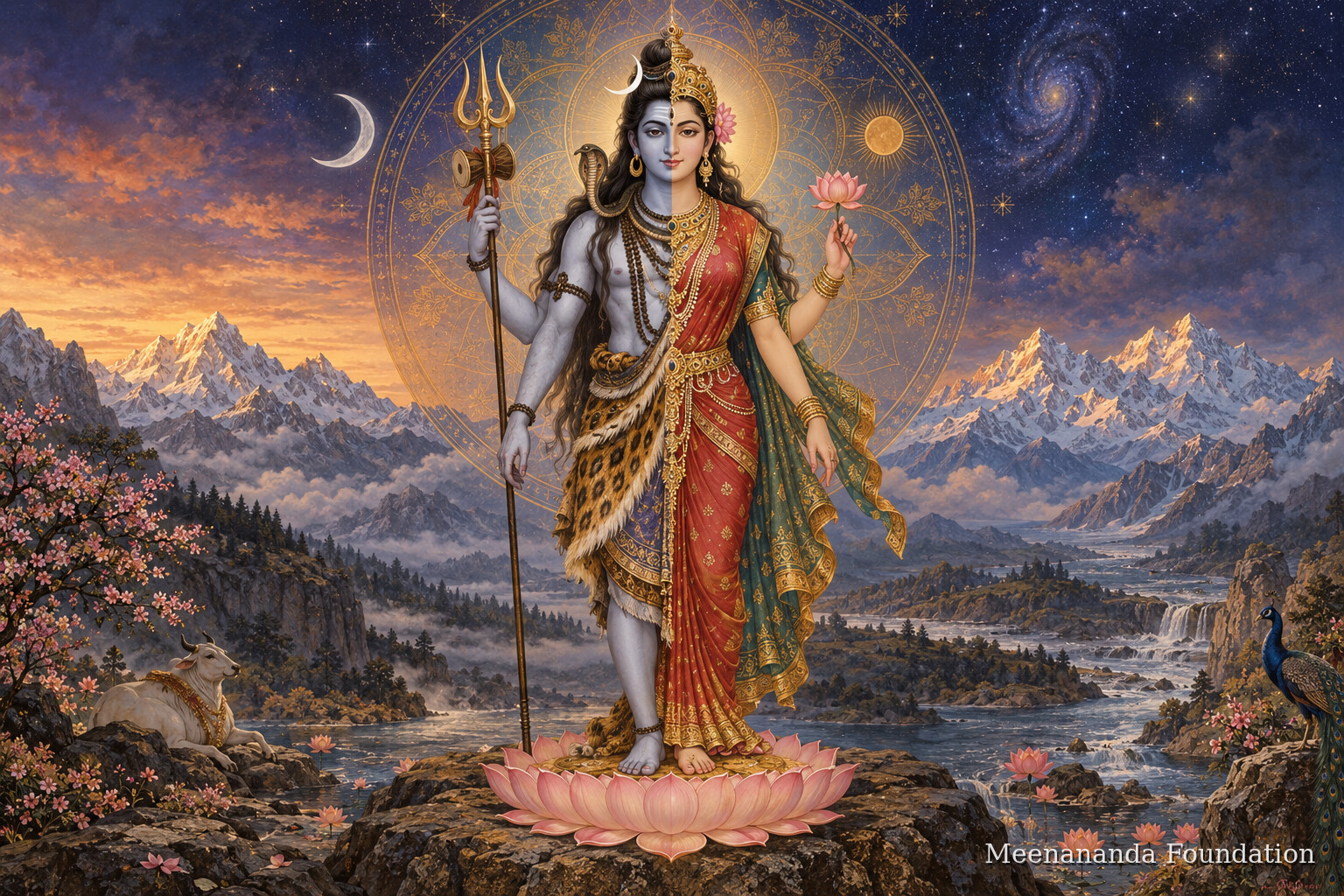
Ardhanārīśvara—“the Lord who is half woman”—joins Śiva and Pārvatī in one body. The image is not merely two figures standing together. Difference remains visible, yet the dividing line belongs to a single form. The icon therefore invites contemplation of unity that does not require sameness.
Awareness and power
In many Śaiva and Śākta philosophies, Śiva can name pure luminous awareness and Śakti its freedom, power, expression or capacity to appear as a universe. These are not two independent substances later combined. Awareness without power would be inert; power without luminous awareness would be unintelligible. Their distinction helps thought, while their inseparability points beyond dualism.
Traditions formulate this relation differently. A Śākta source may place Devī as ultimate; a Śaiva work may speak of Paramaśiva whose freedom is Śakti. Sāṃkhya's distinction between puruṣa and prakṛti is sometimes used in modern explanations, but it should not be assumed to be identical with every tantric Śiva–Śakti theology.
Reading the icon
Historical images vary. The Met describes the composite as indicating the śakta–śakti relationship of the whole. Attributes may include Śiva's matted hair, crescent, trident or serpent and Pārvatī's ornaments, mirror or lotus. The balance of sides and arms is not absolutely uniform across time and region.
The image can be read through several complementary lenses:
- cosmic: stillness and manifestation belong to one reality;
- devotional: Śiva and Devī are never truly separated;
- psychological: qualities conventionally gendered masculine and feminine need integration;
- philosophical: oppositions arise within a deeper nonduality;
- social: viewers may question hierarchies that treat one gender as spiritually secondary.
No single modern reading exhausts the icon. It should not be used to erase actual women, gender diversity or social inequality under a vague claim that “everything is already one.” Sacred symbolism becomes ethical when it deepens respect for embodied persons.
Nonduality is not indifference
Tantric nonduality is often misunderstood as permission to ignore distinctions. Yet the capacity to see unity can make distinctions more, not less, precious: teacher and student, consent and coercion, medicine and metaphor, public teaching and restricted rite. Ardhanārīśvara holds difference within wholeness; it does not make discernment disappear.
Contemplative invitation
Without attempting a restricted visualization, a reader may simply sit with the icon and ask: Where do I mistake complementarity for conflict? Where do I demand uniformity before granting dignity? What becomes possible when still awareness and creative action are no longer enemies?