A reading-part — editorial, not the author’s chapter title
Insight
Printed pages 162–214.
Jagatik Ajagatik · Part 1 · Printed pages 171–223
Printed page 162
Shashwata and Prashanta both sit on the earth and take Pagla Baba’s two feet. Pagla Baba: you find your existence at the feet; and I search my existence inside you. Tomorrow your Guruma will come. Three days later is Purnima; that day is fixed as the day of your diksha. You do not delay more today; return quickly; tomorrow morning come with Bouma and the boy. Now finish eating-drinking — and he enters the room. Shashwata rises, in joy clasps Prashanta, and Prashanta Shashwata. In emotion, in longing, Shashwata putting his head on Prashanta’s shoulder keeps doing jalabhisheka of joy’s tears on the shoulder.
Printed page 163
That day I had not come to know any word about you; I had only gone saying my own words. Shashwata: from now we two are not only friends; we are here children of one Guru, so we are dada-bhai, what do you say? Prashanta: yes, you have said right; you are my guru-bhai; from after meeting you it is as if my fortune opened. Such a Guru, and such a brother, a human being gets only by fortune. Tell me, what age will you be now? Shashwata: counting-counting much has happened; leaving thirty-one I have fallen into thirty-two. Prashanta: what you say, a small boy; yet my guess was right; it had to be thirty-two. Shashwata: so your guess is quite exact. Prashanta: no; actually looking with numerology, now your Jupiter dasha is running; and in this dasha Guru-prapti happens. That is why I had guessed. I again have a little—
Printed page 164
Let these things be now. You had said you would come again after one day; I see one day has become one week. Prashanta: no brother, every day your word came to mind, yet circumstance again and again stopped. You know all the state of my house. Thinking your word, last night I made the mind firm. First this fear — would I meet you again? Having left you, had you gone somewhere else? Coming here in the morning, not seeing you, I thought perhaps I would not meet you. Asking Baba, he said you had gone to bathe in the river. Yet as I had left you, in these few days you have somehow changed. Shashwata: how was I? Silent, shy.
Printed page 165
Shashwata: take, take, now finish eating; you are much late. They pranam Pagla Baba; Prashanta leaves the kutir. Shashwata goes a little way, shows the courtesy of love, returns. Pagla Baba remains inside alone, door shut, doing his own kriya. Shashwata finishes his work, cooks the night meal; after eating together Shashwata lies alone in the verandah. Tomorrow again Guruma is coming; the many days’ wish of seeing her with the eye; with the day of diksha in front, with a little fear, a little joy, he sleeps. Before the dawn birds call, sleep breaks. Then dark like night on every side.
Printed page 166
In the dark suddenly before the scrub on the right he feels someone; lifting the hurricane to see well he shudders — what is this? Something long that has taken a human form. Shashwata, afraid, cries out. The two dogs rise barking, run toward the scrub. Shashwata without going further quickly sits up in the verandah. What was that? Ghost, or some other beast? Oh how terrible; it was looking and looking at me as if aiming at me. From fear the whole body sweats; there is no courage or wish to look again. The two dogs after crying a while come back and sit silent in their place. Now Pagla Baba’s mantra-path comes to Shashwata’s ear. Getting Pagla Baba’s voice, courage increased, Shashwata goes to make tea. Pagla Baba, pratah-kritya finished, comes out.
Printed page 167
Pagla Baba: you will get it; habit takes time; if you fear, yet in fear there is no fault of the throat. Do not go to wear a medal becoming over-courageous. What you have never seen, seeing it in front, there will be fear; in that there is no shame either. Be it beast or ghost-Bhagavan. Those who do atmahatya, they too are very courageous for that. People do a little to live, and see these — they themselves in their own heroism end life. And shown daredevilry, whether you say the world or that world, in both worlds judges them lower than beasts. Your friend Tuhin wanted to come to you; he himself had called his death from before, had fixed this twenty-seventh date, because the day of his first meeting with his wife was also the twenty-seventh. Tuhin had thought if he ended himself that day, he again—
Printed page 168
Actually he could not accept Rupa’s death by drowning in water. He had let the word of his death be known before. Shashwata: but Rupa’s dream? That in such a way her death would happen. Pagla Baba: many times our unconscious mind, sleeping or waking, gives a hint of something, good or bad; that is why a human being can guess. If there is much thought of a subject, a guess of its good and ill comes in front, and walking that path events may also happen according to that guess. Yet Rupa’s death did not happen from drowning. She had heart-failure. But this was not any destiny. This was an accident, of which Rupa had received a little hint before. Such things happen with many. Shashwata: and Baba, Tuhin’s other kind of conduct and speaking in another language, that—
Printed page 169
Pagla Baba: your friend once wanted to see Rupa. He had thought he would ask her forgiveness, and going to search her he keeps feeling Rupa’s existence inside himself. Tuhin understands if the body remains perhaps two will not be able to see two, and then he makes the mind firm to leave his own body. Then he thinks of you, because he does not want to lose you too. On the night of the twenty-sixth he decides, not later, now he wants to go with you to Rupa. Then what happened you know. Shashwata: uf — putting hand to the head he sits in the verandah. Pagla Baba: there is one cause of letting you know the whole event. What you had come on the path to know, that has now been let you know. From any event that has happened the sutra of another event begins, which beginning your abhisheka on this path has been started. From now—
Printed page 170
There one only enjoys the yantra of one’s own karma-phala. From that yantrana one cannot find a path to free oneself. That is why that layer’s name is pretloka. To get free from that preta they want to go to sadhakas, because a sadhaka can do work keeping the samata of both worlds. A preta has no power of its own work, so it tries to have some work done by a sadhaka aiming at it. And if the sadhaka truly does some work aiming at it, then it receives uddhar from pretloka. Shashwata: but why does Tuhin want to come to me? I cannot even see him. How shall I do work for him? Pagla Baba: he wants to come to me aiming at you. That I may free him from this yantrana.
Printed page 171
Leaving the body, as fruit of that, in this pretloka a human being must pass as preta. So while the body remains one must do work and, from this play-house of papa-punya, pierce pretloka and pitriloka. And mukti from this life-cycle can then be gained. Shashwata: then can he in no way gain mukti from this yantrana? Pagla Baba: yes he can. If you wish he can gain mukti and again take a body. Before that you must do sadhana and wander in both worlds. Then you must give him some fruit of your own work. That kriya too I shall teach you. Binding yourself in a raksha-kavacha you must uddhar him. If your friend Tuhin’s ending himself has become the beginning of this path of yours, then your reaching the peak of this path will become the beginning of his new life again. So all of yours now—
Printed page 172
Only with your ashirvad the rope of my hand — I too shall have to enter sadhana. Do not fear; on that path you will walk; the Guru’s ashirvad will also be able to show you the path. If I can now, I too shall one day be able. Now it is late; go to your chikitsalaya; if you can return a little quickly. Yet do not leave the patients. For your diksha many things will have to be bought. Quite much money will be spent. The doctor’s money which you left on my asana, I have kept in a box. Take those rupees and pass the day of diksha with quite some show. Doctor, if you do not spend much, I shall think you a kipte, and people again.
Printed page 173
Two kinds of madman. One madman coming into this world, saying mine-mine, keeps earning kamini-kanchan, filling the bank, thinking my wealth will make me deathless, at last giving to another leaves the earth. Another madman coming into this world, wishing nirvana, to mix in the formless, to remove I-ness, remains busy in unworldly work. Leaving all busyness, thinking even in pebble-stone the existence of the brahmanda, searching Param Brahma, keeping him in front, he sits eyes shut. On the other side people remaining in worldly work, in the busyness of growing their I-ness, do not get two moments’ peace to shut the eyes; they think if the eyes shut I-ness will go, so to keep themselves alert they do not even want to shut the eyes. So these two kinds of madman, seeing one another, keep laughing calling mad. In the midst some worldly madmen, at an unworldly madman’s, in what joy—
Printed page 174
Shashwata: will Guruma come alone from Kolkata, or will someone bring her? Pagla Baba: that I cannot say. Whether they will leave her alone, or reaching with son-daughter. A little time passing, it will be understood, what do you say? Shashwata: that is right. Actually I was thinking, taking your order, whether I shall go once to the station. Pagla Baba: no, no, you need not take the trouble to go to the station. Even if she comes alone she will know the path and reach here. He enters the kutir. The watch’s hand has passed six. Quickly Shashwata goes to bathe in the river. Standing on the bank he looks well at the far side. Arka and Arka’s mother’s word comes to mind; searching her, the river—
Printed page 175
A mala in this way from end to beginning again a new name’s turn — this is life; who knows who ended today his yatra-pala. From curiosity Shashwata goes forward to see the shava’s face: ah, not much age. What happened to the girl, he asks a middle-aged man standing beside the shava. Unknown fever; keeping seven days in hospital she could not be saved. Shashwata: oh. What age will the girl be? Gentleman: this, nineteen happened; talk of marriage was going; in the midst of that in this way Bhagavan stole her life. Turning to Shashwata: seeing you I think you are the sadhu-baba of this place. What kind of judgement is this of Bhagavan’s? The girl had only begun life; now she had to die? Shashwata: yes, so. He who gave prana took it again; the power of judgement is empty to you and me.
Printed page 176
Pagla Baba: and the body is all right? Seeing you I feel somehow tired. Today again there was word of some people’s food here. That is why perhaps your tiredness caught my eye more. Actually people remaining empty-stomach from far a long time, getting the taste of the quality of your cooking, they have not become tired. So you do one work today: even if not ill, pretend a little to become ill; in that your tongue and belly will become still more well. Shashwata, a full smile: to give joy to tongue and belly my mind too for some days has been wanting; eating only niramis the mind had truly become a little ill. Baba, is there any vidhi in shastra of eating niramis? To do puja one must take niramis ahara, otherwise the sin of jiva-hatya will stick — I have heard much such; yet you eat everything.
Printed page 177
The word of such pashu-hatya has been published in all dharma-granthas. So for the protection of dharma, in Kurukshetra in the palana of dharma-raksha, hatya was done. And in this nature in all places there is the existence of prana, be it jada or plant, whether seen with the bare eye or not; so if you take only water as food, in that too the existence of prana will be found, because one prana-shakti entering another prana-shakti, nature has kept its samata. In this nature from the tree’s flower the fruit that has only taken form, one day leaving branches, becoming old, will fall on the earth and rotting leave its form. So meat-muscle, though it forms today, tomorrow again rotting will mix in earth. This is nature’s rule. Then is nature a slayer? No, this is nature’s dharma. Who creates, he—
Printed page 178
Offering to Bhagavan, taking as food, in that too is there papa? Eating having samarpan to Bhagavan, Bhagavan will free from papa. Because in that hatya there is no view of cruelty, nor is that hatya of any kan-bheda prani. In such thought many prani, though they make sound, their body does not leave sattvikata. That is why niramis ahara has been held as sattvika ahara. Actually in ahara there is no sattvikata; to build oneself sattvika one must make one’s bhava sattvika; all must be loved, shraddha done; not limited only in some large-formed prani. All are part of that endless shakti, and all have taken birth in this nature for some purpose. So if hatya is thought, every prani is continually slaying someone. In this way the life-cycle has been built. As the fierce beast of the forest—
Printed page 179
From food some unfolding of the mind’s bhava can happen. To increase the gati of the senses some mahapurushas have given the counsel of taking niramis in the list of food, by which a human being can protect himself from the measure of the senses’ uttejana, and as much as possible controlling himself can live an ordinary life with shuddha chitta. So to all they have given the counsel of living with the mantra of deha-shuddhi and the help of ahara, doing nam-gana of Bhagavan. But on this path the reverse rule. That is why again many mahapurushas have gone mentioning this path. The path is not for all. Who has atma-vishvas, is able in samarpan of himself, has sahaja control toward the senses — he will be able to go forward on this path. That is why all are not caught and brought on this path.
Printed page 180
Milk, which is pranija ahara, that too they take counted in amisha ahara; from this vira-bhava many sadhakas showing the sign of their sattvikata, meeting in Bhagavan, taking the akhya of atimanava, still today receive puja on this earth. As long as this earth remains, they will remain deathless on this earth. Remember, you have not come taking ordinary diksha to spend this life. Lighting fire inside yourself, burning your worldliness, to meet in the unworldly source you have set foot on the path, which can uddhar you from this life-cycle. You will now enter Shaivachara. From this achara you will obtain knowledge concerning the jivatman. In this way, entering knowledge one achara one, entering vira-bhava, conserving the obtained knowledge, becoming a virachari sadhaka in that knowledge you will take yourself forward, leaving daridrata, raja—
Printed page 181
And according to that kriya the fruit-rules remain separate. Understand, Shashwata? Shashwata: yes Baba I have understood. To touch the peak of the mountain, atma-vishvas and control, both are needed, with the Guru’s ashirvad. Otherwise in the kshaya of time even the chance of parikrama of the mountain is lost. He pranams Pagla Baba. Pagla Baba lifts him: take, it is late, finish your work. The sentence not finished, Prashanta enters with his ginni and son. Seeing Shashwata and Guruji talking, the three stand at the small gate as if their coming were at an unfit time. Wanting to enter taking permission, Prashanta from outside the gate calls Shashwata. Shashwata turning: come, come — and goes forward to open the gate. The three together enter the kutir.
Printed page 182
Pagla Baba: you are not a person of coming with another’s wife; yet say, Bouma, have any Thakur given you darshan before? Bouma, not understanding much: Thakur-darshan, Baba, not very much; I have not done Thakur-darshan in mandirs. Yet here in Haridwar some time ago we used to go toward the hills; some darshan of those places too, not much more, and now small and large mandirs have been seen. Baba, the body does not give at all, so I cannot manage. Pagla Baba: no, that is not a word of being able. Shiva-Durga-Kali you have obtained darshan of, living. And that, they say, has again given you such a future-vani: as long as you live, remain dead with eyes open. And if you stir, the eye too will shut. So stirring cannot be done. And Animesh, you again—
Printed page 183
Jyoti, Ish — jyotisha: jyoti means light; Ish means path, that is the path of light. What kind of jyotishi, he will show you the path of light; he only held out darkness. That is why perhaps before you he is not only a jyotishi. A much greater jyotishi, who even shows darkness. Leaving jyoti-darshan he has obtained siddhi in patal-darshan. And with that siddhi he has made you too enter patal. You too have understood: in patal there is no thought of the future. So you too have no thought of the future. Leaving studies you have remained a patal-vasi. Learn to see with two eyes open. In another’s eyes, only hearing the story of svarga-naraka, joy or sorrow is found; oneself cannot see. Believe, but do not be blind-believing toward anyone. In the meaning of the word vishvas itself, as much knowledge of one’s own—
Printed page 184
So the time that is found, apply it and keep obtaining various knowledge; as fruit of that, when dying will come, perhaps what dying is will have become known. So before dying do not remain dead. Learn to apply this body to know what happens if one dies. There is no gain in fear seizing that which will one day come. Rather conquering fear, learn to live. Go, from now live to know; do not live to die. Understand, Animesh? Animesh: yes Baba I have understood; from now before dying I shall no more fear death, so I shall not waste time either. You have said right; I had believed him like a blind man without judging. Taking his word I had remained dead before dying. Now I can understand, he is no jyotishi, a vesha-dhari thug. Pagla Baba: your such a beautiful form, two such beautiful eyes Bhagavan gave you.
Printed page 185
Anima, meaning Anima Banerjee. Pagla Baba: now what age do you make, Anima? Anima: that, Baba, I cannot say exactly; I think forty-two to forty-three. Pagla Baba: women’s age-count does not remain exact. Let it be, how much did you say? Forty-three. Let it be all right; I took forty-five. Suddenly again turning to Shashwata: you do not keep standing; go to your work; I see if I am not there you will not even go to work. Shashwata: yes Baba, I go now; and remaining with you the mind does not want to go anywhere. Only it seems if I leave you I shall float like straw in flood-water. Pagla Baba: go without more delay; do not float in flood-water; only keep the mind on this path; you will see again in the ebb’s pull you have returned to me. Shashwata without increasing words pranams and sets out.
Printed page 186
Yet in this case mentally you had quite broken; that is why it seized so. Anima: shall I become right again now, Baba? Pagla Baba: this, you have already become right. From this ghati take two sips of water and put a little puja-prasad in the mouth. Tuk-tak six months, the knot of the brow twelve months. Your six months twelve months have all happened. From now you go. Now do the cooking; patha-meat has been brought, which Animesh loved to eat from your hand. Let us see whether Animesh understands cooking, or whatever he gets he eats well. Animesh: in the matter of eating our family has quite a good name; relatives all used to say we understand nothing but eating and sleeping. So mother’s cooking was much praised. Once eating her cooking, they said, many days—
Printed page 187
Pagla Baba: Prashanta, you go show your ginni everything a little; I have no more courage to remain before her. Anima, Prashanta will show you. And you, the khunti, the sword, and the pieces of meat — thinking Reba’s brother, kosh well; then you will see there will be no more wish to feed him kochu-siddha. Saying this Pagla Baba enters the kutir. Meanwhile Shashwata reaches the doctor-khana a little late; patients have crowded standing in line. One by one a patient enters and comes out. Today again Guptaji, a white envelope in hand, waits hoping the crowd of patients will lessen; he wants to see Shashwata-babu a little. Shashwata, finishing seeing patients, quickly gathers the bag. Today again Guruma is coming; the longing to see her is of many days.
Printed page 188
Shashwata, envelope in hand: on the envelope nothing is written — who has sent this prashamsa-patra? Guptaji: I do not know; a gentlewoman came and said give this to you. Asking what is inside the envelope, she said only his prashamsa-patra. I have not seen her before. Asking who are you, she said I am his known. Only tell him Arka’s mother left this for you; then he will understand. Shashwata starts: who, Arka’s mother? Guptaji: yes, you know her? Shashwata: yes, yes, very well. Did she let it be known when she will come again? Guptaji: no. There was word of coming again, yet she gave no word. Why, is there much need of yours with her? Shashwata: yes, meaning all right. I come now — and sets out.
Printed page 189
Your Guru, keeping boundless trust toward you, is opening this path of sadhana for you; so you too, showing the honour of that trust, going a little further will find me; then both of us will have need of both. Meeting you again now is only the wait of time. When the right time is you will see the meeting will happen. Like you I too remain looking at the path in impatient eagerness to meet once more. I hope you will let no one else know the word of this letter; only see whether I have let all be known exactly right. Remain well; now then I come. Iti, Siddha (your known, Arka’s—). Reading the letter Shashwata stands before the kutir. The head has somehow become golmal. What does this Siddha-devi want to say? Her name too as if is in the name; what I want, that I keep getting. So for me her path—
Printed page 190
Until meeting her again no answer will be found. Thinking, going to enter the kutir he remembers the word of not showing this letter to anyone. Quickly he fills the letter in the bag, then enters. Prashanta: here Shashwata has returned. Animesh, give Shashwata-kaku water. Shashwata, glass in hand: how are you? Has Pagla Baba gone out somewhere? Animesh: no he is in the room. Shashwata: where is Boudi? I do not see her. Prashanta: Guruji said today you yourself cook; so she is cooking. Hearing Guruji’s word Anima now feels well as before; tucking cloth at the waist she went straight to the kitchen as if altogether magic. Shashwata: no, no, not magic. He had certainly given some dust and a few sips of water; that dust and water in the belly, in the head.
Printed page 191
Animesh: look at me once; seeing me how do you feel? Shashwata: even looking with a doctor’s eye you seem well; you say how you understand. Animesh: Guruji has altogether swept the ghost from my inside; now I have become fully stirring. When the plate of rice and patha-meat comes you will understand how well I have become. Shashwata: bah, bah, this then shabash; come let us see how far the cooking is. Entering the kitchen: Boudi, shall I do something in the hands? Anima: wait Thakur-pon, I am now at war, and when I war I again take no one’s help. You need do nothing. My cooking is finished. Today eating you will see how I have rubbed Reba’s brother in oil and water. That great sadhu had sat dressed; before falling in Yama’s house in hot oil I here—
Printed page 192
He will understand I am wanting to hide. Anima-boudi: why, do you again want to hide something? Shashwata: yes, take this — you and I are joking here, and you told me not to tell him our joke. I perhaps did not let it be known. Some days later, or even now, he may say, what, what you are saying or hiding I do not know. Yet by your not saying I perhaps kept the word; then you know what ought to be done. Anima-boudi: now I have understood your trouble — not our joke being hidden, but if something else happens which is always hard to say, that is the problem, what do you say. Shashwata: I actually want to hide nothing from him, nor is there that wish, because that he will know all of me is my only wanting. Emptying myself, surrender to the Guru.
Printed page 193
And again on that same earth one returns taking a new name. Not being able to free oneself, one keeps turning here. I want mukti from this chakra. My kshobha, sorrow, love, joy — he who had given them to me, I want to return them to him, lighten myself, and meet in that same origin. And the address of that source only my Guru can give me. Prashanta and Anima have been hearing Shashwata’s words astonished. Anima-boudi: bah, your words are beautiful; hearing you I feel if we too could think like you. You have become a sadhu even before taking diksha. Now I understand why Guruji has held you so at himself. Shashwata: this bhava is not mine — it is his taught word; I only recited, and in that I have somehow become a sadhu and received bah-bah. Never mind.
Printed page 194
Life, as if remaining grateful to you, then this receiving of mine from you will become successful. Pagla Baba comes out of the room: has your fire been put out, Anima. Anima: yes Baba, long since; now if you order I shall serve. Pagla Baba: yes, do so. Come, Shashwata, let us judge Anima’s quality and see whether diksha can be given. Asanas spread in the verandah, all sit together and truly enjoy the midday meal by Anima’s quality of cooking. Pagla Baba: Shashwata, how did you understand the quality of cooking? Shashwata: eating my own cooking the tongue had almost gone numb; today as if prana returned — rare. Pagla Baba: you have said right. It would have been better if you were a dentist; feeding your cooking the tooth could have been pulled; pain and injection and then—
Printed page 195
Pagla Baba: this quality of cleaning will be of still more use after taking diksha; then apply this quality again to clean your own mind. So now do not show the whole quality; keep a little jammed. Now all together do the cleaning. Shashwata: yes Baba, we all together shall clean; you go in the room and rest. When Pagla Baba has gone to rest, all clean well around the kutir. Prashanta: brother Shashwata, will someone bring Guruma? Shashwata: that I cannot say; yet I feel surely someone more will come with Guruma. As he speaks, Suman enters the kutir and clasps Shashwata. Shashwata: suddenly you? Suman: I brought Ma. Shashwata: Ma has come? Where is she? I do not see her.
Printed page 196
Guruma, hand on Shashwata’s head: so you are Shashwata? How is your Pagla? Shashwata: I am very well, Ma; taking him there has not been much trouble. Guruma: then you have not yet felt the torment. First see where he is — taking the boy’s hand she enters. Dada-Boudi, Pagla Baba’s son, sit in the verandah. Boudi: Shashwata, this is our Guru-putra. Shashwata, smiling, pinches the cheek: what is your name? Guru-putra: I am your Guru’s boy; my name is Dushtu, and the school-name is Aishik Mukherjee, and I now read in class four. In which class do you read here? Shashwata: I have not yet come to know the names of the classes, so I cannot tell you now what I am reading; yet my name is Shashwata. Dushtu: that I had already understood. You are Doctor Shashwata.
Printed page 197
Shashwata: altogether living Ma Durga — as in the Durga-puja mandaps of Kolkata’s neighbourhoods the murti stands, just so a walking murti of Ma Durga. Now, talking with Guruma, the rule of my diksha and a bazaar-list must be known; for that Guruma must be sat a little apart. Rama-boudi: it is hard to get Ma alone here; what you must know, know from Ma in the midst of all, otherwise the whole day will go trying to get her alone. You had said right; our Ma is truly of the form earth makes, and the mother’s mind as soft as earth. Seeing anyone’s pain she herself as if melts. See, hearing your word Ma was thinking much of us. You are alone with Pagla Baba, so she was saying, the boy has come new, and with such a mad Guru—
Printed page 198
Pagla Baba: here, Shashwata, come this way, and take the list of your diksha from your Ma. Looking at Guruma: listen, do not leave him anything — write my cloth, your sari, all, and beside cloth and sari write a little the word costly. Guruma: all right, I shall write all, and cloth and sari he will bring costly. Shashwata, buy two than of cloth and on one write Jai-Guru, on the other Jai-Guruma, and bring them; then we shall see what more costly cloth your Guru and Guruma want. Actually as you have received a Guru, you must become such a disciple; yet do not think; I shall make you a disciple worthy of a worthy Guru. Guruma makes the list with Shashwata. Shashwata, the diksha-list in hand, mind overflowing: after so many days the fulfilling of the mind’s wish is in the hand. Pranaming Pagla Baba: I go now.
Printed page 199
Pagla Baba: then even returning the morning after next would have done. If your two hands and feet could walk as far as your buddhi can run, like your Guruma’s, then bringing all tomorrow would have done. You do one work: go with them, do a little cunning, make yourself a donkey and stand silent; then when all the buying is done, like a donkey load it on the back and come. Where the worth of your buddhi is not received, remaining a donkey is good, what do you say. Go, do not delay. Guruma, hand on Suman’s head: you are a very good boy; your mind too is very simple. You know before diksha how much work there is. When those things come I must arrange all, so there is not much time. If you go with them, three together, holding, all the things will come at once. Have you understood, Baba. Suman: yes Ma, now I have understood. We—
Printed page 200
Guruma has already risen from the bed early. You have done well; now go to the river and finish bathing. Shashwata, understanding her bhava, takes the torch and sets out. In the dark, seeing the path by the torch’s light, he reaches the bank. Standing, he looks at the far side; in the dark nothing is understood. He leaps into the river, swims, and rises on the far bank. Dense jungle; nothing falls on the eye. In moonlight he goes toward the jungle by the path from which Siddha-devi had come out. He enters that path and goes a little and a little. Now and then the sound of beasts’ going comes to the ear. Hardening the mind he wants to go a little further. Inside this dense jungle, Siddha-devi—
Printed page 201
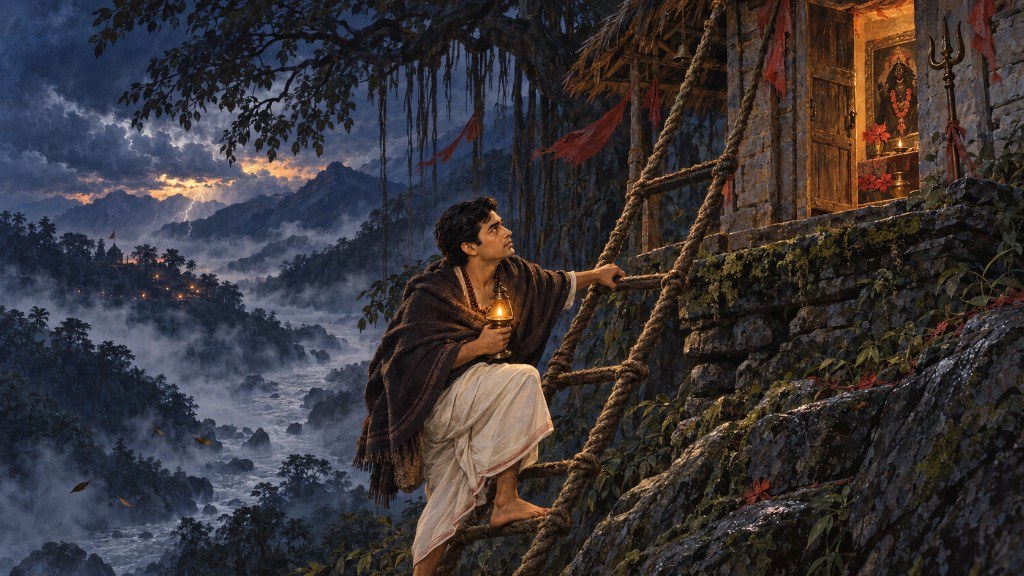
Even reaching he finds no stair to the kutir. Turning the right side of the kutir, a hanging rope-stair is let down. Shashwata, foot on the rope: now I have understood; here Siddha-devi comes; perhaps she is still in the kutir. Quickly he climbs. The door is shut; a light knock from outside and the door opens. He enters: where? No one is inside. A large earthen lamp is burning. Beside, a large wooden-framed picture of Dakshina Kali; beside that a human skull, red tilak drawn on the brow of the skull; and there a strange-looking coconut vessel. A very beautiful scent has filled the whole room. With much curiosity he goes to see a little more around the room when suddenly a gust of wind—
Printed page 202
Morning has only come. One man is bathing in the river. Seeing a human on the bank Shashwata’s fear lessens a little. Pulling himself out of that terrible feeling he returns on the kutir path. Perhaps Arka had said right — ghosts stay there, and seeing an unknown person they show fear. No, this way one cannot go there alone again. Thinking, he returns to the kutir. By then all have risen and each is busy in work. Pagla Baba is standing in the verandah. Shashwata pranams. Pagla Baba: you rose very early today to bathe? That is good, finishing work early; yet remember, there is also much work that cannot be done before time. So if that work is done, before anything is understood, danger comes. Now go, do the works of your time. Shashwata: yes Baba, from now I shall only wait for time.
Printed page 203
Rama-boudi: Shashwata, I see you have brought very good things. Ma’s sari, Baba’s cloth too have become very beautiful; one must praise your choosing. Shashwata, smiling a little: in that matter I have not yet become very self-trusting. Sari, jama, cloth — people choose by colour and thread, each in his way. Those for whom I brought these can again, any colour and any thread, colour in their own way. So going to the shop, seeing once, I lifted these. Rama-boudi: whatever the Guru will do, the Guru will do; I am only a nimitta. Shashwata: no, that thought too has gone far. He whose foot-servitude I have received — in that I do not feel shame even to think myself great. If the sanjivani herb is not found, saying Jai-Guru I shall lift the whole mountain. Who has become a servant of the feet hears the flute of dying and living.
Printed page 204
Singing, Shashwata lies at Guruma’s feet. Guruma clasps him: come, I shall make you hold that foot; in my heart-lotus seat him where Shiva has become shava. Your ishta-form Ma — give him five ahara; the jiva-body of yours will fill. In his name japa the mala; keep him hidden; he will be revealed, yours. A boat will come to you and take you to that ocean of jnana. In light with light he will play; he will wear a mundamala. Leaving the body, the cut head, by Mother’s khadga unknowing is lost; in two arms varada-abhaya; in dhyana see him; in your own heart there will remain no more doubt. Mohini, kanchan, all is dust. Ending the song, Guruma, hand on Shashwata’s head: seeing your bhava I am mugdha; these days doing guru-seva you have been able to raise yourself much. Therefore I want to give you a little more responsibility now, by which you—
Printed page 205
Pagla Baba had been standing beside Guruma. Shashwata pranams Guruma and lies at Pagla Baba’s feet. Pagla Baba lifts him: Prakriti’s wish is the jiva’s wish. Tomorrow I shall make you strong. Your abhisheka and gatabhisheka will happen together; becoming adhikari of jiva-form Shiva and shava-form Shiva, you will do shakti-sadhana. From now, taking Guru-shakti as ishta-form Mother-shakti, first pranam her, then me. And going to do this shakti-sadhana, shakti must never be neglected — be it Guru-shakti or one’s own shakti. Guruma to Shashwata: go, take joy; you are becoming altogether a Shakta. Shashwata: all is your kripa; by kripa you opened this path of mine. Guruma: how many shaktis like me are gracious; you come forward, that is what they want. Now go to your doctor-khana.
Printed page 206
People go about doing others’ anishta; yet in that I have not much fear. As it is, carrying one or two ghosts I keep seeing good and ill; if I err, two more may sit; and if I can do the reverse, all those ghosts will come down from the neck, and then there will be no need of criticising this one’s and that one’s good and ill; one’s own future can be seen. So to make one’s own future, wherever the Guru says to do sadhana, striking a pranam I shall go there. Guptaji: Shashwata-babu, seeing good and ill — is that a bad thing? Shashwata: seeing good, ill, jnani, ajnani, becoming ajnani, the ajnani must not be judged. In that only a human’s ahamkara grows, and this ghost of ahamkara holds the human and does not let one mix in the light of jnana. So as long as this ajnani ghost sits pressing on a human’s head, until then another’s good and ill must not be judged.
Printed page 207
Guptaji: I have understood. Talking with you I must master this kaushala of yours. You have said right; ordinary people like us only regretting think ourselves great. Never mind; today I shall not delay you more. I wish at Bhagavan that your aim be fulfilled; in that I too shall have much upakara. Shashwata rising: as fullness comes of itself, so the aim comes. So if you, thinking my word, wish fullness, your fullness will come. Today I come; we shall see again. Shashwata returns to the kutir. In the kutir a great crowd of disciples, all sides arranged beautiful. Entering, a wave of joy as if mixes everyone with everyone. All finish work and lie to pass the night. Shashwata’s whole night more or less stays awake. Thinking, this dawn has come, this dawn has come, he sits up.
Printed page 208
Now with shankha-dhvani puja will begin. Pagla Baba sits on the puja-asana; on the left Guruma spreads an asana and sits. One after another puja keeps flowing; all sit silent in a crowd around the puja. After a good while the room’s atmosphere as if becomes empty of worldliness and an unworldly hint covers all. In the midst Pagla Baba keeps sounding the bell and reading stava. Rama-boudi and Anima-boudi remain busy in the work of cooking bhog. Guruma by a sign tells all to go a little outside. All come out. Shashwata to Suman: what, brother, are you too fasting today? Suman: no, why should I stay fasting; you will take diksha, you will fast. Yet I have not eaten much from morning, and the day has gone quite far; now a little hunger-hunger is coming. Shashwata: then eat; yours—
Printed page 209
Dushtu: all right I kept it; now you say, putting this hand of mine, what you received. Shashwata: putting this hand of yours, the fire of my hunger was soothed, and with it the mala of jnana also increased. Dushtu-babu: let that be; now teach me giving injection. Shashwata: that I shall give; you yourself are my Guru. Can the Guru be disobeyed? And I feel in your word there is go; if you give injection, a separate syringe will not have to be given you. Mixing with you any patient will become well and go home. Dushtu-babu: saying those things will not do. Today I leave you; tomorrow you must teach. Suman: yes, yes, Dushtu-babu, tomorrow he will teach; now leave Shashwata-kaku. As they speak, Rama-boudi, the bhog-thala arranged, goes to the puja-room. Shashwata: here, Rama-boudi has come out with bhog.
Printed page 210
And seeing such torment of the Guru here, no one will even want to become a Guru. Suman: you have said so. That is why you see I am not increasing the diksha just now. Dushtu-babu, playing: increasing diksha does not make a Guru; increasing jnana makes a Guru. So Suman-kaku, without fear, increase the diksha. Shashwata laughs ho-ho. Suman: now more words cannot be said; see who is beside. One Guru sits in the room at puja; another Guru is wandering outside; if a little wrong is said he presses. In this way another hour goes. Then from inside Rama-boudi calls: those whose diksha will be, come inside. All go quickly. Pagla Baba first gives mantra in the ear of Prashanta, Anima, then Animesh. Then, sprinkling Shashwata with Shaktabhisheka, he accomplishes the abhisheka and shakti—
Printed page 211
You will feel tired; yet a little later he will give the water of shanti. When that water falls on the body all will become right. Shashwata: all right — and again remains looking at the sky. Pagla Baba, puja and homa finished, gives shanti-water to all disciples. Time rolling, almost evening has come. He orders all now to take bhog. Guruma: Suman-kaku, come, sit quickly; the time to quench your hunger has now come. You, not taking diksha, remained empty-stomach so long, and seeing your sorrow I too remained empty-stomach. Shashwata: ahare, you too eat something, this much a child, not eating so long. Dushtu-babu: how shall I eat, say — you who will take diksha fast, Ma-Baba who will give diksha fast, in the middle shall I remain full-belly. Shashwata: from where do you get so many words. Dushtu-babu: I do not know; Baba said jnana happened.
Printed page 212
Pagla Baba: Rama, today keep one asana and a pancha-patra arranged separately. Guruma: Shashwata, has your eating-drinking happened? You remained long; was there no klesha in fasting. Shashwata: no Ma; yet ours all happened, and we see your klesha. Guruma, smiling a little: klesha? To cut klesha we have come on this path. Seeing from outside, klesha; inside, only joy and joy. See, now one more pagli will come. Hearing of your diksha-anusthana she too is very glad. Shashwata: who, Ma? I have given no one any news. Guruma: she needs no news given; if she thinks, all news reaches her. She knows you well; yet you have not yet been able to know her. Then, crossing the small gate of the kutir, Siddha-devi enters. Shashwata, astonished: are, Siddha-devi. Guruma: come, come, Siddha.
Printed page 213
And your introduction I want to know walking the path with you, because Doctor Shashwata and the sadhaka I already know; to know Shashwata I have come here today. First go inside quickly, otherwise your Pagla Baba will chew and eat me. As it is I have come here a little late today. Now then I come — and she enters the kutir. Shashwata pranams Guruma: Ma, bless me that I may give Siddha-devi the introduction of sadhaka Shashwata in the proper way. Guruma blessing: from now you are no more only Doctor Shashwata; the introduction of sadhaka Shashwata will be your true introduction. This blessing I do you. You wait a little outside now; we finish our puja and come. I hope, receiving adhikara quickly, you will be able to remain with us in that puja-room. Now I come. Guruma—
Printed page 214
The abiding of two in the midst of one. I myself am sura, I myself asura — the sura’s place is the house of svarga; the asura will go to the house of patal. Sadhana-work will say where my place will be. Every human’s life-journey is built of two sattvas, whose right valuing is an easy way of tasting, inside oneself, the flavour of godhood. ISBN 978-93-87800-86-4. Sanskrit Pustak Bhandar, 38 Bidhan Sarani, Kolkata 6. Phone (033) 2241 1208. Rs 295. End of Part 1.