A reading-part — editorial, not the author’s chapter title
Meeting
Printed pages 1–53 and the bhumika. Gomukh, the train, Haridwar.
Jagatik Ajagatik · Part 1 · Printed pages 1–62
A note on the author might have been wanted here. I hold back for two reasons. First, in the quarrel of the worldly and the unworldly, the true author’s privacy is always to be guarded. Second, the point is not that readers should trail the writer, but that they should walk with the people of the story.
It should be said that even if the writer’s learning began in scripture and books, by the Guru’s blessing he has tried, in the gravity of this silence, to let us know a truth: that inside the seeming deathlessness of earthly and unearthly powers a seed of destruction is hidden. In our understanding the writer keeps a quiet, gathered vow of silence.
Preface
This writing is not a fairy tale, nor a story told only for the tale. It is an unknown account of the hidden power in every living being that grows in this nature.
The wise and the unwise alike lean on that power and plan the future without fear. Drunk on the taste of permanence in this passing world.
I know I shall end, and leave everything. Still, let what is mine remain mine. I know the source of life is bound in your hand, O Maker. Still I cannot drop the thought that I am great. O God, open this mood of mine. Light in this life the lamp of knowing, and in that fire let my I-ness burn. Jagatik Ajagatik, written in the letters of this life-cycle, is a telling of events formed around a few of our own characters.
Some people, like us, caught in the knot of happiness and sorrow, and wanting to cut the mind-made joy and pain of life, have set out on the road to Haridwar.
Tasting Mother Ganga’s nectar in small sips, becoming a jar filled with nectar, wishing to meet at her source — our view of life mixes with their path. If the compassionate Mother grants her grace, we shall all one day be whole.
In that thought this is only a small attempt. My small wish for it is this: if you do not take it as a mere story, but as a true seeing of our life, I shall remain grateful. I pray that the auspicious Mother give everyone right understanding. May all be well.
Printed page 1
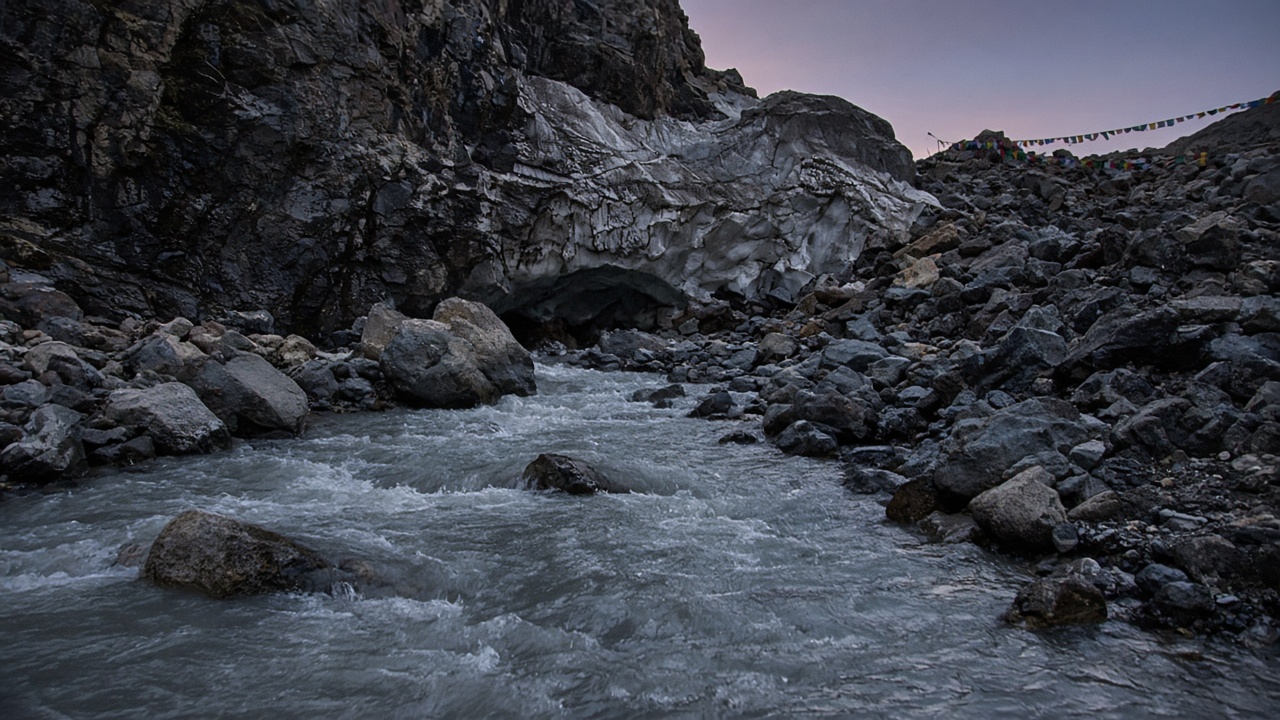
Gomukh is the place of the Ganga’s rising. It is said that in the stir of her youth she found a place in Shiva’s matted hair. In the Hindu dharma her holy water is named nectar, and at her touch poison fails. From this Gomukh, by Gangotri, on the road to Haridwar, Mother Ganga first set her foot on the plains, carrying the breath of the living world.
On the path of a sādhaka’s life, Gangotri is a longed-for place for the seeker raised in the Mother’s courtyard. There many have set their aim and tasted nectar. They have dived into the pot of nectar and brought up the store of nectar-knowledge.
Only the thirsty run to have their thirst quenched. When craving rises in the very arteries, then one may see the Guru as knowledge, the store of nectar in his hand. At his feet one empties oneself, leaves the rise and fall of a needless life, takes birth in rishi-ground, becomes a star of deathlessness for the earth’s span, and, wanting more than a human life, walks the Guru’s path; with the Guru as companion, newly tasting, in the sap of creation, Mother Ganga’s motes — motes that, gathered small to small, can float a human being’s heap of sin away.
And so, it seems, many still run with the wish to become a sādhaka. Trusting blindness, they surrender at the feet of an unknowing guru, lose the path, judge scripture’s good and ill, become beasts in human shape, seat the guru in the thousand-petalled, and, with Mother Ganga as witness, keep Ganga-pūjā. Showing the folly of thinking themselves seekers, they enter the nether world.
In the midst of this beautiful nature a poison-tree is perhaps needed. This poison
Printed page 2
— from this very poison, in the urge to make nectar, Mother Ganga keeps moving without rest. From a special weight, even in this Kali age, a sandbank forms on Mother Ganga’s breast. Standing on that bank, people plant seeds of untruth, bind their chest with the hope of God’s blessing, and make pilgrimage. They forget: in a tīrtha, the coming and going of needless poison can crack the sky itself, smooth the road for a true sādhaka’s arrival, and call the sādhaka.
From the dust of the road the ranges lift their heads; unknown trees rock; waters without a visible source; rows of trees raining blossom — as if drunk on a coronation. And then the mind says, “O God, how beautiful you are; for me you have laid this plate of offering.” Where shall I keep this rare taste? So I have set it today as my Ishta in this universe: you, only you, first brought this māyā.
Bound in that māyā you too call, empty. Forgive a child’s unknowing. You are this world’s great Māyā, Dasamahindī. From the Mother the soul’s source-net; in the body the sound of mantra rises; the vehicle of letters begins. After the Guru’s appearing, after the seed of the full body is planted, Ganga’s water, Giriraj, sits on the seat and beckons — the head anointed with scent from Ganapati’s feet. The walking of the path begins. Under open sky, on every side, the sādhaka’s word of fearlessness is scattered.
Now go on — from Kolkata, boarding the train, a Bengali son of a brave mind, remembering the foreign land, greedy to know himself by courage and enterprise, cutting fear, wearing pride as an ornament, climbs into the train.
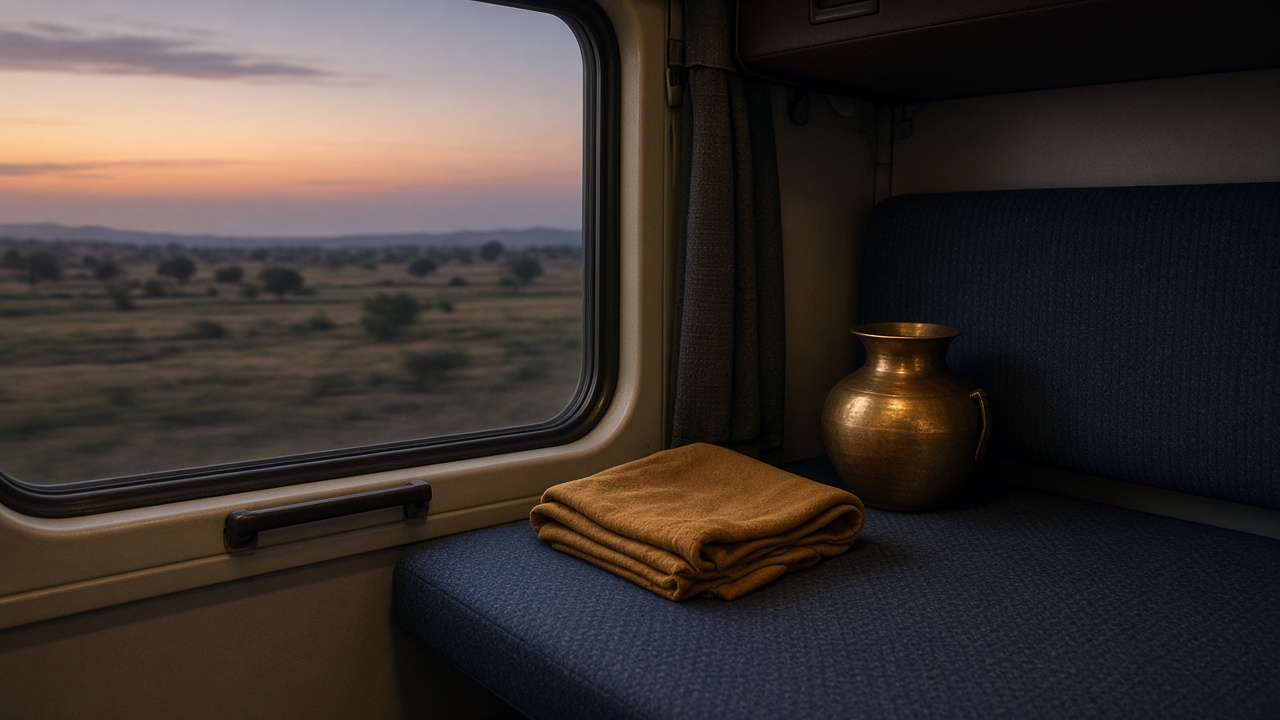
In the train’s rocking the eyes close. In dream the source of Mother Ganga opens. In the ear her walking-song: kal… kal… kal… kal. What does she wish to say? So much still unsaid. I think I will listen hard — and then trouble comes: someone calls that Benares is arriving. We get down in a hurry. Noise on every side, needless shoving. The noise cuts, and yet, still seated in the carriage, there is a glimpse of Baba Vishwanath.
Printed page 3
So many sit, boats filled. Far off a chain of islands floats; the scene is very fair. Someone seems to call with a wave. The two eyes flash: on Mother Ganga’s bank someone is lost in dhyāna, dived into the sea of bhāva, and has found the trail of a jewel.
The train moves again; the bell sounds. Baba Vishwanath’s dwelling slides from the eyes. Passengers change; something new is seen. A new voice in the ear. A flood of people in many dress. One man in a sādhu’s guise: gerua cloth, thick sandal marks on the brow, a great jhola on the shoulder, a tulsī mālā at the throat, past fifty, long hair knotted. Sadhu Baba has made himself a little room among them all. The train gathers speed. From the bag he takes a water bottle, pours a few gulps down his throat, and with “Hari Hari” knocks a pranam.
One passenger had been watching the sādhu’s performance. Looking at his face he suddenly asked—
Passenger: Where are you going, Baba?
Sadhu Baba (softly): Haridwar.
Passenger: Are you a Vaishnava?
Sadhu Baba: Yes.
Passenger: Then why Haridwar? Not Mathura or Vrindavan?
Sadhu Baba: In love the love-play is found; Hari and Hara are all play. Mathura or Vrindavan — in Haridwar too, the Vaishnavi’s feet.
Passenger: Then why so much road? Are you Vaishnava, or Shaiva?
Printed page 4
Sadhu Baba: Light the lamp and see — is the light yours alone? Shiva gave the fire; the Vaishnava is smeared with ghee; the aim is that light; we think it different by works. Thinking you and I are human, we know the life-breath is one. The mind’s ache will go only when you dive empty in Hari’s name.
Beautiful! Beautiful! A traveller spellbound by mantra. Sādhu! Sādhu! — that cry only. As if Mother Ganga herself were pouring the abhisheka. The holy clay-scent of the tilak drifts in.
The train’s wheels, that had kept time, stop. Now it is everyone’s turn to stop. The passengers’ noise thickens again in the ear. There will be darshan of Mother Ganga — that is the wave of joy in every mind. Haridwar has come.
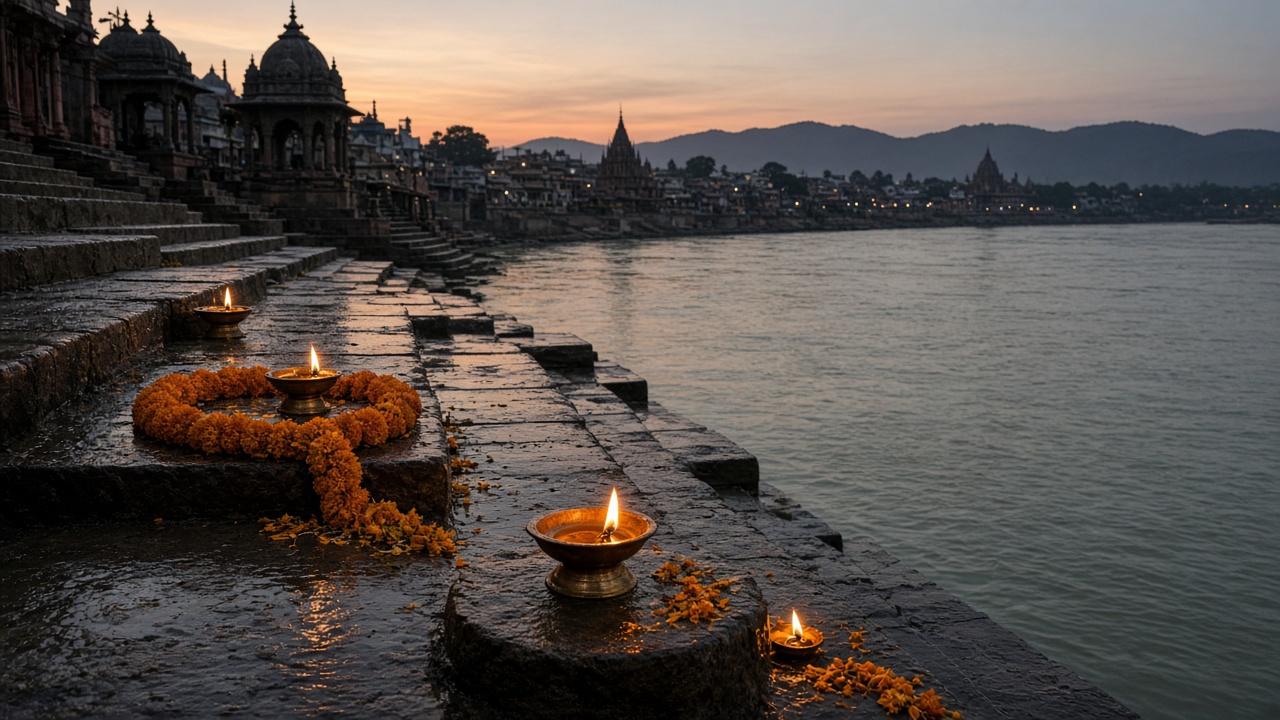
Outside the station a line of small and large cars. Quite a gathering of people. On the roads, hotels and dharmshalas in plenty, and large. This Haridwar has been touched by modernity. A meeting-place of all jatis, and many sights. The special draw is Har Ki Pauri ghat, where every evening Mother Ganga’s arati is done with much show. Ordinary people crowd there too. On Mother Ganga’s breast one may leave the sin one has earned.
So ordinary people dive into Mother Ganga with devotion, and in her wild ongoing motion, as a handle for the mind’s desire, they light a lamp and set it floating on her breast. They wait that the lamp may not sink. If a lamp is seen floating far off, there is a belief
Printed page 5
that the heart’s wish attains fullness.
In the evening Mother Ganga’s Ganga-arati is very fair. On the bank some young men stand, lifting great lamps, praising Mother Ganga, with modern Hindi bhajan. Light on every side. The cool wind off Mother Ganga gives ease. Even in the crowd, a true sādhu is hard to meet then. Saints are busy in their own places with their own inner work.
Besides, from such a fair of craving the true sādhu thinks it good to keep far. “Sitting on the shore of the sea of bhāva, apart from the sea’s happy craving, he keeps himself separate in the wish to meet the sea and touch both banks.” And to enter that meeting-work he follows the path the Guru gave.
When the evening rite ends, each leaves Mother Ganga’s ghat toward his own aim. Suddenly a sādhu in black dress appears on the ghat. Quite loudly he cries “Byom-Byom-Byom.” A great trident in the hand, black cloth bound on the head. On the brow a long black tilak. The sight itself is frightening. Some eyes are drawn, yet not everyone dares come near. Among them one, hoping a mahāpurusha has appeared, touches his feet.
Sadhu Baba: (saying Byom Shankar, lifting him) What is your trouble, child?
A man of Mark’s years: Baba, I have many obstacles; no work is accomplished. Bless me, that all my work may be accomplished. He gives a rather fat dakshina. And Baba, pleased, touches the trident and says.
Sadhu Baba: All your work will be accomplished. Go, son, all your work will be accomplished. There is no more fear.
Printed page 6
Another self-forgetful young man had been watching Baba’s doings. He had come to Haridwar from a need of the Guru. From the wish to know the Guru he sat and asked—
Young man: Baba, are you a smashan-dwelling Aghori?
Baba: (laughing with Byom Shankar) No, son, I am not only a smashan-dweller; I remain in every place. Removing people’s sorrow and misery is my vow. So, having gained siddhi in sādhanā, I wander the roads and bless the unfortunate and turn their fate. Say, what is your trouble? At the touch of this trident it will be ash at once.
Young man: But I have heard a siddha sādhaka is hard to meet? Only by much punya does one get his darshan. In truth, Baba, I have no trouble; I want to be cut from this worldly moha.
This time Baba, saying “Byomshankar,” gives no answer and leaves the place. The thug-Baba goes on, wanting some other eye.
This is what samsara is called: in a sādhu’s dress there is no shame. Look to Mother Ganga: in many colours, how many thugs. Why this play? In two days, lost to yourself, your raft will come; you will know the burn of hell. In this world this is the play — a fair of thugs in the Guru’s guise.
Printed page 7
The self-forgetful young man goes on, an unbending wish in the mind: he wants sight of a true Guru. He leaves Har Ki Pauri ghat. Evening has dressed the roads in light; crowds pour from large shops and small. In that evening mood, among people, he stops at a tiny stall to quench a thirst for tea. There he falls into talk with a man of a pandit’s kind, who from the store of his learned memory begins to tell the purana of Haridwar: how from which king Bhagiratha, by how many years of hard tapasya, brought Mother Ganga to earth; how when her unstoppable force set the mortal world afloat, the God of gods bound her in his matted hair and let a portion enter earth from his kamandalu; how living beings woke in her nectar; how from the ice-cold high stream she set foot on the plain and joined the sangam here in Haridwar. Mother Ganga, hotri of the ten directions, abides here as Durga of the mortal world. He tells of her seven streams and the tapasya of the seven rishis; Prajapati Daksha’s yajna; Sati’s giving up of life; the beginning of the fifty-one pithas around this Haridwar. Unknown facts, unknown roads, the gathering of sadhus at Kumbh — the door of the gods’ land is this Haridwar. How many tantrics come as a handle for siddhi of works, wander and make a camp in hill, forest, jungle, cave. Hoping to become siddha they embrace hut-life; becoming governors of the senses they enter a great festival of practice; by their own kriya they establish life in stone and remain sunk in their own world.
Printed page 8
But the young man asks: where do I find such people? I have come running in the madness of all my wanting. Have pity; tell me now where I may see them. The pandit says he knows one tantric who wears no sadhu’s dress, does not speak purana, and in easy words a view of life is found; in his mind he has already taken that one as Guru. Before that man’s true seeing the head bows; in the sharpness of truth sin seems to become ash. Young man: What? You have not received mantra-diksha? Pandit: Not yet; even after much asking, permission has not come. Young man: Then he does not give diksha? Pandit: He does. He has a handful of disciples who do not even pranam a god in his presence — they hold that all tirthas and all godhood abide in him. Touching his feet a human being tastes godhood. The man who, being human, receives human worship blesses with a hero’s force and sends them forward on the path of sadhana. He lets them know: the Guru, knowledge-form of the universe, removes blindness. When blindness goes, there is darshan of light. That trust is what is called a Ganga filled with bhakti. The young man: Then come, take me; I too want his darshan.
Printed page 9
The pandit says such a man’s trail is hard. On the bank of the Saptadhara, in the middle of jungle, there is a small kutir, of course — yet even there his darshan is not always had. Day and night, try as one will, he is not caught. Wait; perhaps on this Purnima the fortune of taking a Guru will come, and Guru-Purnima will begin. Talk runs late. Tomorrow I shall take you to that Saptadhara bank; perhaps his darshan will be found; for today I go. The young man’s fire grows; he almost wants to run at once. Friendship is sealed: we meet tomorrow; the walking of the path will start, if we find him. Binding the mind in a light of hope, only the night is to be crossed. In the morning perhaps he will hear many of that man’s words; even without the eye, it is as if the Guru has already been met. After the night meal he lies thinking. In excitement and longing he spends a sleepless night and rises in Brahma-muhurta. Outside, perhaps, his friend is already waiting to take him to that darshan. He comes down to the road, runs to Mother Ganga’s bank. Dark has not yet broken. Mist on the paths; in the ear, stotras of the Guru; in the greatness of the gods’ land, the taste of Guru-vandana. In the mind he pranams the Guru and Mother Ganga. The sky is only then dressing for arrival, like a bride in a veil, flushed with shyness. In that fair scene, nature’s rare form, a new waking. A sannyasi — tall, thin, past fifty, a large salt-and-pepper beard. From both sides of the head a special jata, a braid,
Printed page 10
has come down to the knees. On throat and wrist rudraksha; on the brow a round dot of red sindur; a white dhoti; bare-chested, a white uttariya wrapped. Morning rite done, he sits on the ghat looking at the sky, as if he would merge with it, float himself with the flying cloud. In a clear gaze his mood can be read. The young man, hoping for sadhu-sanga, goes near, pranams, sits beside him. The sannyasi’s look falls on the youth. Sannyasi: What do you want of me, child? Young man: Nothing — only a little blessing. Sannyasi (laughing aloud): That is the priceless wealth of life. What greater thing can be asked? Young man: But Babaji, I have left everything and come; I have nothing more to take. Without your blessing how shall I reach my aim? Sannyasi: What is your aim, child? Young man: I want to know God. I want to be His servant. Leaving others’ servitude I want to be servant of Him whose world this is. So, begging blessing, I want to reach my aim. Sannyasi (smiling softly): Alms yield food; blessing is found when work is done. So this path wants that work. Young man: But Babaji, I do not know my right work; still every morning and evening I read stotras of the gods, and with devotion the hymn of Mother Ganga.
Printed page 11
Sannyasi: Bah, bah — very good. But child, if you sit outside the house of work and work, does wages come home? First you must enter the house of work; then you must do the work the master has set; only then may you hope for wages. To walk toward an aim you need the trail of the path; otherwise you will wander and lose the aim. As light is needed to walk in the dark, so on this path, without a Guru, work is vain. I have shown as much of the road as I can; after this, search for him who will open this path’s door for you. I go now; my morning-evening time has come. Young man: Babaji, do you stay here? Sannyasi: No. We are sannyasis; we have no fixed place. We wander and make a camp — today here, tomorrow somewhere else. Young man: Babaji, in which mata have you taken sannyasa? Sannyasi: Mata! All matas are one, child; the roads are many, and every road, wandering, means that same mata. “The trail of the path is many; every mata means Brahman. From form the formless comes; in the thought of difference a path is chosen.” (reassuring the youth) You will surely find a Guru. God calls everyone; only a little stillness, and His call is heard. I go now, child; if you remain on this path we shall meet on the path again, and talk much more. On this path a companion is greatly missed. Young man: Babaji, we shall surely meet. I too want to set down this load of sorrow.
Printed page 12
Give me then the jhola of begging. Sannyasi: No, no, child, I am not he. Guru is a much greater word. He will come; when the time is, he will give you darshan. The sannyasi goes on; much work remains for him. The young man looks: much time has passed; clean light has broken on the roads; on Mother Ganga’s ghat people have begun to come and go. What happened in that while? Bhava still holds him. A little forward he takes the built ghat’s steps, from the cold racing water lifts a little in two hands and dashes it on face and eyes. The body is eased by the cold touch, yet the mind stays heavy. To quench tea-thirst he comes up to the road; beside, in a tea stall, milk has only begun to boil on the stove. He asks the gentleman there for a cup. Two more come and stand. He keeps thinking the Babaji’s words: how many untruths we take for right, and grow our I-ness. We ourselves reign in our false palaces, and by reading a handful of books we sit in judgment on God. Suddenly he remembers his friend. Ah — where is he? It is late; who knows how far they must go. Where is he? Yesterday he said he would take me, restless, to that Guru’s darshan. The young man looks this way and that; perhaps he has not yet come. A little on he sees: there he is, standing to one side of the road. Black trousers, a sky-blue short-sleeved
Printed page 13
shirt, glasses, fifty-five to sixty years. The young man goes quickly on long steps. Young man: Friend, how long have you been standing? Pandit: This moment, only just down. Young man: So late? I have been waiting long. Pandit: No, brother — much work at home, so a little late. Come, we must catch a bus; from here it is a good way. The stand is beside them. They board quickly, take two good seats side by side. A few people sit scattered. Not much crowd. Pandit: Almost two hours of road. In this gap we can talk and make the friendship firm. Young man: Who is in your house, friend? Pandit: We are three in the household — I, my ginni, my son. My ginni has been very ill for some time; her hands and feet have no proper strength. A little work and she pants. How many doctors, how many vaidyas. Who knows what disease has seized her. No medicine works any more. At last — what shame to say — we showed a mental doctor; that too gave no fruit. My ginni is very good; she tries much; the body does not give. Now I understand it is that woman’s work, so the doctor’s medicine does nothing. Young man: Whose work? What woman? Pandit: A few of us friends used to go into the hills, and there we met Anurag and Reba. Reba is Anurag’s—
Printed page 14
Two years ago we all went to trek Rupkund. My wife and son went too. Reba, though of a sturdy build, had little spring of life; even panting she loved to climb. That time too it was a seven-day trek. With wife and son I spent ten days with the others. Anurag mixed with us. In much talk Reba told us of a brother of hers, said to be a great tantric and jyotishi, with much name and much money, who can do anything, and for money can settle any trouble. Hearing of that brother we too wished to see him once. After the trek Reba promised one day to make the meeting. A day was fixed. The boy was then nineteen, had passed the school-fence in the first rank; the ginni was very glad. Eager to know the key to the son’s future success — perhaps a high life was waving to him — we went early, with zeal, devotion, trust, to the tantric brother. A busy man, many people; with Anurag and Reba we entered. Reba told our identity. The brother, smiling, asked us to sit in the next room; Reba used the chance to praise him a little more. A costly, well-set room; furniture well arranged; one could see the business had caught well.
Printed page 15
The brother’s age was not much, yet he had quite a baba-baba air. Costly red cloth, large rudraksha at the throat, red tilak on the brow, a heavy look that made him seem older; the dress itself was a little frightening. Now the tantric brother came to us with a full smile and sat on the sofa. We pranamed with joined hands; the boy rose and touched his feet. He asked the boy to sit before him. Tantric: Your name? Boy: Animesh Banerjee. Tantric: Let me see, Animesh, the lines of your hand. (With a lens he examines both palms well.) Hn — a yoga of high learning shows; the line of good establishment has risen clearly. Ginni (smiling): Is that so? And marriage? It will be well? He will not make it himself? Tantric: No, no — your boy is not like the boys and girls of this age; civil, with faith in Bhagavan; all will be as you say. Yet one problem — (looking at the hand more carefully, and at the brow). All right; I shall say later. Ginni (quite eager): Why, did you see some trouble? Tantric (face heavy): Yes. On the line of his brow a great danger is seen. Pandit and ginni (afraid, together): What danger? Tantric: Even if all else is right, Animesh’s span of life is seen to be very short. That is, at twenty-five the noose of death — which is understood quite clearly.
Printed page 16
Ginni (afraid): What are you saying? My only son! The tantric (reassuring her): No, no, you need not think so far. There is a remedy for everything. That is why I have gained siddhi in the Mahamrityunjaya mantra for people’s welfare. With one kavacha I shall cut this noose — yet the noose of death is not a small word, and a homa must be done. For homa and kavacha quite a lot of money will be needed. Pandit: How much might it cost? Tantric: See, you have come with my dear elder sister; you need not give much as my fee. A hundred will do. But the puja’s cost alone you must give — ghi, wood, honey, and the kavacha — some forty thousand. For less than that this noose cannot be cut. Hearing this I too became very afraid; my head was not working; an only son; knowing the noose of death I had no courage to delay or take counsel. So I agreed at once, left an advance of thousands, and with joined hands prayed that this brother would remove the danger. He held my hand, said he had done such work many times before, promised success, and told us to arrange the rest of the money quickly. “I shall give it; please begin the work.”
Printed page 17
Then we returned home quite heavy-minded. Both of us were in much thought. Animesh, though he said little, his manner changed; knowing the noose of his death he seemed to drop all hope of his future. From then he did not wish to go out much. Leaving friends he wanted to stay alone; eating too he almost gave up; if anything was said he seemed afraid; mentally he quite broke. As soon as we put the money in Reba’s hand, within three days Reba arrived with that kavacha, and said that even in such busyness, dropping everyone’s work, her brother had done ours first; and hanging the tabiz on the boy’s throat with red thread she said, now Yama will not be able to break the door. But the boy stayed sunk; he did not go to college, did not go out; if anything was said he said he would do everything again only after passing twenty-five. Studies dropped, he sat at home. Seeing the boy’s conduct, the ginni and I, thinking of his future, wishing even now to change his mental mood, again took refuge with Reba. When we told Reba all, she spoke with her brother; the brother, hearing, spoke of another maduli to free him from this kriya, and sent asking for another ten thousand. When even after putting on that maduli no change was found in the boy, my ginni kept telling Reba again and again. Reba kept reassuring: all will be well. Some days passed this way; when my ginni again told Reba there was no fruit, then their form changed.
Printed page 18
They called the ginni a liar; her siddha-purusha brother — none of his work, they said, goes vain. As a result my boy still lives almost like a madman. And because words were cut with the ginni, Reba’s tantric brother threatened: he would finish the ginni with a marana-ban. A few days later my ginni truly fell ill. After that, doctors, tantrics — we did many; no gain. Whichever tantric I went to only took money, called himself a great siddha sadhaka; nothing of work was done. When I had dropped all hope, a trusted friend of mine named That One. After so much cheating I had no trust left in anyone. The friend asked me many times to go; I then agreed, but catching him was hard work. He has no business in these things. So there was no fixed place or time. Even so I met him a couple of times, yet no chance arose to tell him this matter, nor did I much wish to. Young man: But why? You had gone precisely to tell him. Pandit: I do not know. But hearing his talk one seems to receive much peace. There is perhaps much to learn from him; the little time one gets hold of him runs away only in hearing him. The ginni and I met him once, and even told him of taking diksha as a couple. He said, “It will be, it will be, keep contact; when the time is you will get it. Before making a Guru, the Guru must be tested well, and in that gap the Guru too will know the disciple.”
Printed page 19
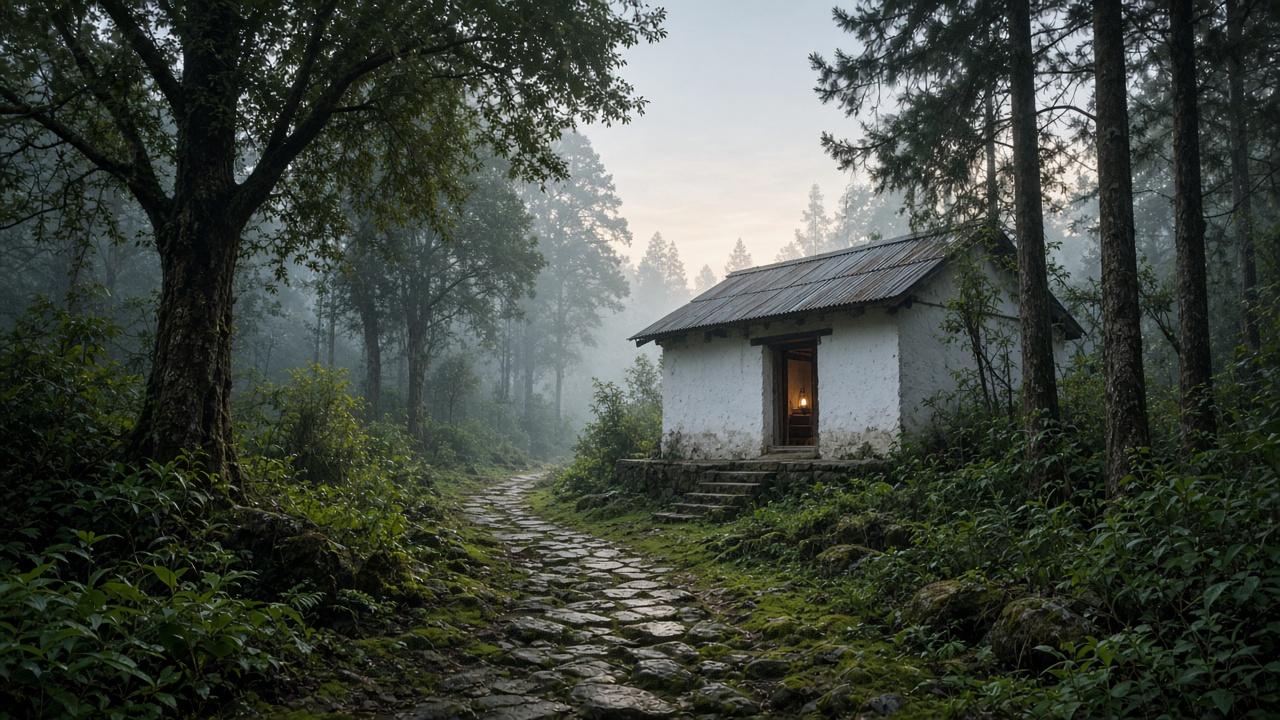
“The farmer scatters seed only after knowing the soil. If it is stony ground, paddy will not grow,” he would say, and smile a little. “Leave all that; we must get down soon. A little more, then we get down in front of that small shop. Come, we rise.” From the bus they get down, brush the shop, take a narrow earth road toward the jungle. A little on the road grows narrower; from large trees to small, the density of jungle increases. There is not much coming and going of people, yet the sound of their own feet feels like many walking together. After almost fifteen minutes’ walk the kutir is seen — jungle wrapped in great trees, weeds cut, a quite clean earth courtyard; at the entrance a small gate of bamboo slivers; inside quite clean, great trees on every side. A one-roof kutir, a large verandah; inside it seems one large room. Made of earth, bamboo, hogla leaf and thick tree-trunks. The door of hogla and bamboo slivers. The roof of tin. Seeing the kutir both minds rise; they enter on quick feet. In the open before the kutir they stand and pranam toward it. At the sound of dry leaves of their coming, a middle-aged gentleman comes out of the room, with a lady; he in pajama and a special fatua, she in a white sari with a red border, a large red tip on the brow, sindur laid broad in the parting. It would be about eleven. Gentleman (seeing us): Who are you?
Printed page 20
Both (together): We had actually come to see Guruji a little. Is he here now? Lady: He went this morning toward town, to a disciple’s house; but he will be back tomorrow morning. Do sit (she spreads a mat on the earth). You have come from far, I think? Pandit: Yes; I had a great wish to meet him, so we left early. Young man: Do you stay here? Lady: No, no. Pagla Baba — that is, our Gurudev — ordered us to spend the night here today. Young man: Pagla Baba? Gentleman: Actually we all call him Pagla Baba. Lady: He has no fixedness; when he will do what is hard to know, so — a little among ourselves we named him Pagla Baba for fun. But we do not call him that to his face. Young man: When will he return tomorrow? Gentleman: That is very hard to say; I think he will return in the morning. Young man: Boudi, are you also his disciples? Are you initiated, in the tantra mata? Lady: Yes; four years have gone for me on this path, and he is older by another year. You talk; I shall set the rice — something must be eaten at noon. Young man: No, will you take trouble? We shall eat something outside.
Printed page 21
Boudi: If you look at that trouble of mine, you will have to stay unfed. Because here no hotel or food-shop will be found face to face. And our Gurudev went saying, “If anyone comes, do not keep them unfed.” Perhaps thinking of your words he said it. That is why this morning he himself brought fish again, and said, “Cook fish today, and with all these fish make one jhol.” You talk; I go. Even if it is not very good, at noon you will be able to put two mouthfuls of rice in the stomach. (Boudi rises.) Young man: Friend, an invitation to take bhog in a temple — this is our fortune. Pandit: Is there anyone else’s kutir in this jungle? Dada: Yes; behind our kutir is Sitaram Baba’s kutir. He does not come out much; he is very old. Young man: In this dense jungle, is there no fear of beasts? There seems to be no electricity here. Dada: No, there is no electricity, yet there are many living creatures. Fear does not take us much now. This small gate and these great trees stand watch at night. But our Pagla Baba says, “Than the beast in human form this unknowing beast is much better. They hunt only from the urge to live, not to quench a hobby. And if you love them a little and let them quench the fire of the belly, they become pets and even protect the master. So the sadhaka, setting them to work, does not fear them. They stop the obstacle of people off the path, and he can remain in sadhana in quiet.” Young man: Does he do puja and archana here?
Printed page 22
Dada: Yes, come inside the room; this is his rest — a middling wooden bed, hogla leaf on it, two pillows, a blanket and a sheet folded. The floor too is of earth. On one side his place of puja. There some pictures of gods bound on board, pictures of his Guru and Guruma, a few banalingas, a kharga hanging on the wall. Beside it a trident painted red. And some puthis, an asana, and red cloth. On the clean floor a quite cool feeling; the scent of flowers, agar, camphor drifting. In the room an unknown crawling-of-the-skin. Both fear and devotion work. Both, with much devotion, take dust from the floor where the Guru’s foot-dust is scattered and put it on the head. Suddenly the sound of some people coming together enters the ear — many, as if in a band, coming this way, sounding kansar and bell. Young man (quickly outside): What is it? Boudi: Nothing; the poor people of this place come this way to burn a corpse, and go sounding kansar and bell loudly. That is their custom. Young man: Then there is a smashan here too? Boudi: Yes; a little further is the river’s bank; on the bank they gather dry wood and burn, or dig earth and bury, and go. But at night no one comes this way to burn; they wait for morning. Come, now wash hands and face and take two handfuls of rice. Hunger in the belly is much; quickly an asana is spread in the verandah; on a sal-leaf plate, rice, some fried greens, a thin fish
Printed page 23
jhol has been set. The young man sits at once on an asana and asks, And you? Boudi: Sit, we shall sit together! Our Gurudev does not order women to take first — take, begin. Having received permission the young man does not delay and begins the work of chewing. After eating, in the fullness of belly and mind the eyes almost close. Boudi (all work done): Was the cooking all right? No great trouble? Young man: Taking rice from Annapurna’s hand I received only the taste of fullness; I did not even understand the taste of the rice. Boudi (smiling): Baba, are you a literary man? We have not even learned your identity. Pandit: I am Prashanta Banerjee. Young man: And I am Shashwata Ghosh. Boudi: Prashanta-babu, you seem very familiar — tell me where I have seen you? Or is it my mind’s error? Prashanta: Yes, actually I have been able to know you now, and you had seen me at Saurabh’s house. Saurabh means my friend, and your guru-brother. At his house he had called me to meet Guruji at a puja. You were there that day too. And from you I had taken permission wishing to enter the puja-room. You stopped me and said, the puja that will happen now is not done in front. On this path there are many secret pujas. You rather wait a little.
Printed page 24
Then, shutting the door, several of you went inside. I waited outside quite a long time; because you were late I did not meet you. Boudi: Yes, I remember; that will be six or seven months. Saurabh had the puja done with much show. There were invited people too, so I could not notice. So you are here? Well — Prashanta: Yes, yet by Gurudev’s blessing, after many troubles nothing has been able to lay me low. I had hoped, taking the Guru’s permission, to spend this life as a couple on this very path. The sentence is not finished when Boudi speaks. Boudi: Surely — yet, Prashanta-babu, on this path life is not only spent; life itself can be known. Our Pagla Baba says, he who has nothing sleeps away under a tree, and he who has everything stays awake the night in the thought of where he will sleep. So one should live not in spending life, but in the joy of knowing life. Prashanta: Yes, I understand; age has increased, yet the age of bhava has not increased that way. But now I must go; it is a long road back. Come, I rise; tomorrow perhaps I shall not come — some people are to visit the house. Shashwata: Then shall I come alone tomorrow? I have a terrible need. Boudi: Then you, brother, spend the night here. You seem restless; if seeing you is not a great trouble. Shashwata: No, no, what trouble in that? It is my fortune to spend the night here.
Printed page 25
I want to spend my whole life here; that is why I have come. Dada: Then you stay here today, and increase the experience of kutir-life. Prashanta: Then, brother, I rise; many thanks to you. I leave this friend of yours with you. We shall meet again. Give my pranam to Pagla Baba, that is, Guruji. Brother, Shashwata, if I cannot come tomorrow, I am certainly coming the day after. Stay well. Shashwata: Let me go a little way with you. Dada-Boudi, I come at once. (The two leave the kutir.) Friend, how shall I thank you; I have no more language in my mouth. Prashanta: No, brother, spending time with you I too liked very much; telling many stored words of the mind I too feel much lighter. Now you go back; they are waiting. Shashwata: Friend, go carefully; we shall meet again — and, changing the path, he returns to the kutir. Dada-Boudi are sitting in the verandah. Dada: Come, brother, come here, let us talk a little. So, from where had you come? Where is your home? Shashwata: I am coming from Kolkata. After spending two nights in Haridwar I met Prashanta-da, then here. Dada: From Kolkata? So you had come this way to wander? Who is in the Kolkata house? Shashwata: Not exactly to wander; I came here in search of a Guru.
Printed page 26
In Kolkata I stay together with father, mother, dada-boudi. We have a three-storey pucca house. Father is a doctor; dada is a master in a government school; I passed the doctor’s degree, worked some days in a city hospital, then with father and mother’s permission began to wander this way and that, and wandering today I am in this kutir. Boudi: What is this? Why did you leave everything? Shashwata: It is a strange event. A friend of my childhood, from our village, lived beside us — name Tuhin. Tuhin’s people had much property. He was his parents’ only child. His father and mother looked on me as a second son. So Tuhin too was my only brother. Tuhin’s father was an established businessman; Tuhin looked after that business. For the business Tuhin had to go to Ranchi, Patna, Asansol. In holidays I too would go about with him. Days passed in much joy. In the midst of this, one day Tuhin’s mother decided to give Tuhin in marriage, with a girl of a well-known Kolkata family. Tuhin told me to go and see that girl. As said, one day, leaving my own work, I arrived in the morning to see Tuhin’s would-be wife and the ways of their house. Seeing the girl’s form, her aristocratic manners, Tuhin too was quite drawn. As said, the day of the wedding was fixed for November. Tuhin and Rupa — Rupa meaning Tuhin’s would-be wife — wishing to know each other well, began to mix well.
Printed page 27
I too remained in their group. Rupa called me ‘deor’ in fun; I too said ‘boudi’. The relation was quite amusing. At Rupa’s house there was an established Kali temple — nitya puja. On Kali Puja they stayed awake all night; puja, bali, homa with much show. That year Diwali was in October. With Tuhin’s family I too was invited to that puja. All day, all night we spent together in much fun. After seeing the puja, taking bhog the next day, it was a little late returning home. Home, the weariness of a sleepless night, and many stories still left; in that thought Tuhin spent that night at our house. Next morning Rupa’s telephone came; quite fearfully she told Tuhin of a strange dream. A dream of the last hours of night, she said, comes true; that is why she was so afraid. In the dream they had gone to some unknown place; I too, she said, was with them. On the way in a car, from some high place our car fell into water, and Rupa drowned and died. Hearing this Tuhin told Rupa, “Shashwata and I are village boys, both swimming champions; we will not let you die by drowning. Do not wear your head over such things.” But Rupa’s doubt still did not go; she said people say a dawn-dream often comes true, so I am very afraid. Tuhin said, “Yes, it might have been — if in your dream this had not been water,” and laughed ho ho. Hearing Tuhin’s laugh, Rupa’s immediate fear broke. Meanwhile the wedding day came on; Tuhin, by nature, stayed busy with Rupa, piling responsibility on me. I too
Printed page 28
began to give more mind to the wedding work than to doctoring. Watching, watching, Tuhin and Rupa’s wedding happened with much show. Because the work of the wedding was well finished, much praise gathered on my brow from both houses. After the wedding Tuhin and Rupa passed the first month in much joy. Now Tuhin had to go out again some days for business. Rupa insisted she would go with him. Tuhin told me that, and asked me to go with them too, so that Rupa would not be alone when he was at work. Accepting his reasoning I too went with them. From Kolkata we took train to Patna; one night in Patna, then came to Ranchi. After two nights in Ranchi, for a little adventure Tuhin hired a car and wished to return by road. As said, Rupa too was glad. In a plan of returning to Kolkata via Odisha we left at dawn toward Odisha. Then, touring Odisha, on the way back to Kolkata, when we were coming over the Mahanadi, trouble happened. Winter, evening only just down. Our car was crossing the river at speed. On the very last stretch a lorry lost control, struck our car, and our car fell from above into the river. The bank was not very far. We all fell into the water as each could; Tuhin, holding Rupa’s one hand in one hand, with the other swam and brought Rupa onto the bank. I too swam ashore. But Rupa’s body by then had become still. We took her quickly to hospital. No great wound had come to us. The doctor examined and said Rupa had had heart failure. Hearing the news Tuhin lost consciousness. I too, seeing and hearing all, fell silent, and felt quite ill. We two
Printed page 29
were admitted to hospital; Tuhin kept losing consciousness again and again. After three days Tuhin’s state became a little normal, and we were brought home. Rupa’s dawn-dream came true exactly. Slowly Tuhin recovered, yet now and then he began to behave as if a ghost had seized him. By the doctor’s treatment Tuhin was healing fast. Conduct was becoming as before. But sometimes he wanted to be alone, and told me, “Rupa was very foolish; she could not trust me.” Wanting to know how Rupa was, he wished to do a planchette, and became drunk on that desire — whoever would do this work. Sometimes reading books, sometimes catching this one and that, in doing this he went to a Muslim fakir baba. Fakir Baba, they said, was a great tantric, who can bring any dead person before the eyes and make them speak, and can know and tell about them. That Fakir Baba, they said, would give him Rupa’s trail; so Tuhin, drawn to him, kept going again and again. He asked me to go to that Fakir Baba too, but in this matter my trust is very little, so I avoided on the pretext of urgent work. Yet Tuhin, telling me nothing of this, kept going day and night to Fakir Baba. Fakir Baba told him that one evening he should go there with a glass bottle and white paper. That day, meeting Tuhin, he was busy with that glass bottle, paper, and other odds. When I asked what all this meant, Tuhin said that tomorrow evening he would take these to Fakir Baba, and Fakir Baba would bring him Rupa’s trail.
Printed page 30
I tried to make him understand that not going into such things was perhaps better. That Rupa could not be had again — that he would not accept. Ignoring me, the next evening he went to Fakir Baba. Then the next night he came back and told me he had received Rupa’s trail. On that paper, he said, Rupa had written, “I love you very much, Tuhin.” He said he had been able to feel her; Rupa’s body’s scent, he said, still walked with him. Tuhin was very glad that day; he kept trying to make me understand that joy of feeling Rupa, and said he would make me feel her too. I only listened, silent. And I felt much pity for him. In his words Rupa came back to mind; my mind too became quite heavy. Ah, Vidhata — the dreams shut in their cage became birds and flew into the sky. Only the empty cage was left. Stroking Tuhin’s head I came home. Meanwhile Tuhin became busy with Rupa again. After some days of this, Tuhin as if truly saw Rupa and spoke with her. He did business as before; though unnatural, his conduct did not seem to need a doctor. Yet Tuhin would become absent now and then. Suddenly in some other language he would say something to me. I did not understand that other language, that other voice, yet I could understand only one date. Then he would speak normally again. One afternoon I went to Tuhin’s house. Tuhin asked me to sit and gave a cup of tea. Conduct was normal. In the midst of that Tuhin suddenly began to behave otherwise.
Printed page 31
Wanting to hear that other-language speech again, I recorded it. When he was normal I went home; hearing the recording again and again I could understand nothing but the 27th date. On such a day — it was Sunday — Tuhin had said we would spend the 27th together, so in the morning I went to Tuhin’s house. Usually Tuhin left the bed at dawn; that day, though it was late, he had not left the bed. At once he sat up. Seeing me he seemed mentally heavy; perhaps he had not slept well at night. Hurrying, going to speak of tea for me, he stumbled leaving the room, was thrown hard against the threshold, struck his head violently on the iron stair-gate. He became unconscious; consciousness never returned. Tuhin died of a brain haemorrhage. I was then very helpless; he had taken half my life. Even staying upright was hard. After some days, when I felt well, I put that recording of Tuhin’s expert-speech into the hands of an audio expert. After three days his report came. In that report it was written: “On the 27th we shall go. I, Rupa, will stay with you again together. I shall take you. Shashwata too, the rest, quickly—” it was not well understood. Meanwhile these two strange events broke both families. After seeing this report’s writing to me, everyone was afraid. They said I should stay in the shadow of some person of divine power — yet I have not come here from a wish only to live. Is this too possible? I want to know. So today I have left everything here. Till now, astonished, they had been hearing the story of Shashwata’s left-behind life.
Printed page 32
The two of them. Shashwata’s two eyes were wet; as if the true events that had happened before the eyes could have been a fairy tale, a mere false story — then Tuhin could not have gone giving him so much pain. Wiping water from the eyes with both hands: “Actually Tuhin was not only my friend. Tuhin’s falling away is like one limb gone from among the body’s many limbs; it reminds me again and again of my maiming.” Dada: Brother Shashwata, going to search for something lost, a human being sometimes finds an invaluable jewel, at whose touch even the maimed receives a hint of the limb. Do not take sorrow. In life it is sorrow that has made people maimed. Our Pagla Baba says, “Going to search what sorrow is, the days of happiness run away.” Meanwhile it is almost evening. For the preparation of sayam-sandhya Boudi rises and says, brother, you sit a little; we two finish the nitya-kriya. Shashwata sits alone looking at the sky. Before dark, birds in bands keep returning to the address of the nest. Like a closing bell, chirp and chatter, they tell one another the stories of the whole day. Small head, two small wings; tomorrow they will go out again. Life is the name of winning a war; with self-trust, even if a storm’s blow loses the direction, they return. In a new direction. Again the people who burned a corpse are returning — only the sound of many feet; in the nearby mouths no words.
Printed page 33
They have taken their person to burn; after the burning the load of the body is no more, they walk as if floating. While light remains it is well to see the place. Shashwata rises, goes a little forward; to the right, it seems, is the river’s bank, dense jungle in front. A step or two on, inside the jungle he sees another kutir — this too, perhaps, that Sitaram Baba’s kutir, as Dada had said. Seeing the kutir Shashwata goes forward. A narrow path has been made by the print of feet. Small scrub, going, now and then catches cloth and pulls, as if some unknown person wished a little talk. Quite thrilling — walking this path alone. Meanwhile it is almost dark. If there were a torch in the hand one could go a little further. To go on alone in the dark like this is to frighten oneself without cause. So, thinking return to the kutir the wise work, he comes back. At the kutir’s entrance Dada and Boudi are standing. Boudi: Ah brother, where had you gone? In the dark on an unknown road there is fear of losing the path. Shashwata: No, no, just in front, I was here; I looked a little, which way the river’s bank. Boudi: The river’s bank is quite a way; baba, you have courage, I see. Shashwata: No, no, a village boy, used to the dark. So I am not so afraid. Boudi: Yet on this path even in light much courage is needed.
Printed page 34
Shashwata asks why fear in the light. Boudi: you said you would walk this path with diksha. The path teaches one to see the dark as well. In the dark there is unknown fear; in the light, seeing, the bone goes cold. Shashwata: but what is seen, Boudi? Boudi: take this — a human formed of air standing before you, yet you cannot see him with these eyes. When the light of knowing enters the mind, the light of the eyes increases, and in that light he is seen in front. Perhaps he has formed a shape, swaying in the air like a great balloon bound in wind, mouth and hands and body made, calling you, wanting to tell you something, wanting to touch you a little or, showing fear, to move you. This kind of thing is found when one knows the dark. Shashwata: Then can they do harm? Or do they only frighten? Boudi: Mere fear happens in the dark of the mind. In the light people fear after judging. They harm only when there is no acquaintance; when two can see two, unknown fear settles with time.
Printed page 35
Boudi: There is much we have not seen or do not understand. Not to accept that is also a kind of pride. Shashwata: Not pride exactly — yet many have promised much and never shown me such a thing, so belief in this matter has not grown. Boudi, smiling a little: What promise? Who will show you what — a ghost? Can a ghost, or Bhagavan, be shown? That must be seen of itself. Walk some days on this path; he will wander with you; then you yourself will say, I do not want to see any more, Baba, let me be a little alone — and she laughs. Dark has come well; she goes in to light the hurricane. Dada: Have you ever spent a night in such a jungle? Shashwata: I have shut every path but this. I have spent nights in jungle with friends, but not in this hurricane-light. There, light, fan, house — all modern; fear did not take me so. Boudi, hurricane in hand: Then are you afraid here, brother? Shashwata: Not so much; yet in such a scene there is a fear-fear. Seeing you and staying with you, fear is not so; but if as you say something came and stood in front, I do not know what would happen if I saw. Dada: Then I warn you a little, brother — do not put your hand on any thing of the puja if asked.
Printed page 36
If you do, you will see such a thing that the head will go wrong. Shashwata: No, no, I shall not put my hand on these at all. Dada, has your Gurudev ever shown you something unworldly? Dada, smiling a little: He does not need to show anything. Mix a few days and you will understand — the man himself is the unworldly. At first I too was very astonished; a student of science, I tried to judge with the intellect, but I could not make that sum come out. Later I understood some subjects cannot be judged by knowing one thing, so I am no longer astonished. Shashwata: Hearing of Guruji from you, the wish to see him has grown more. He comes tomorrow; I am in much zeal. Boudi: Yes, he comes tomorrow; come, finish eating quickly — if his story starts the whole night will go. At night there is paratha and achar, nothing else cooked; will that trouble you? Shashwata: What are you saying? Paratha inside this jungle — that cannot even be thought. I feel bad that you have gone to this for me. Boudi: There is nothing for you to feel bad. I have called you brother in our bhava; a brother’s work must be done. Come, all sit together.
Printed page 37
In this hurricane light, eating paratha and achar will feel quite good. Shashwata: Yes, come, I too am very eager. After eating: Dada, do you stay here, or elsewhere? Dada: No; some twenty kilometres from here we have a small house; there is our two-person household. One day a week, or one day in ten, we come here; and if he orders, sometimes we stay. Shashwata: Then you are householders; you took diksha while remaining in samsara? Dada: Yes. What of it? If one keeps a household, can one not do puja? Our Guruji Pagla Baba is the same; his house is in Kolkata. Shashwata: Then this ashram — who stays in this ashram? Dada: No one. When Pagla Baba comes here, those who come to see him come to this kutir; otherwise we come now and then and look after it. Shashwata: Has Pagla Baba a household? Dada: Yes, a household in the proper sense — Guru, Guruma, Guru-putra, all are there. Pagla Baba sometimes comes here with the whole family.
Printed page 38
Boudi: Brother Shashwata, can you sleep in this verandah, or shall we arrange a room? Shashwata: I shall lie in this verandah; no trouble at all. He prefers to sleep alone in the hot-season wind. Boudi makes a bed of mat, sheet and pillow, leaves the hurricane, and warns him not to fear. Around the kutir two dogs circle as if on watch. In the stillness crickets sound; great trees sway as if they would touch two people. Shashwata turns the hurricane down. Suddenly in the distance a pack of jackals begins to call, one after another.
Printed page 39
Shashwata lights the torch from under the pillow. Near a thick tree someone seems to move; lighting well, nothing is seen. Thinking it a mind’s error he lies down. The two dogs bark. Lighting toward the tree he sees some standing in a band looking at him — before he can see well, all melt. From Sitaram Baba’s kutir a terrible cry, ai, ai. Fear rises. Drowsiness has only come when he understands someone is pulling his sheet. He cries out. Dada and Boudi come out. Shashwata: someone was pulling my sheet. Boudi takes the torch.
Printed page 40
The dogs are lying; there is no one. Shashwata insists he was not asleep and felt the sheet pulled from his body. Dada: these things happen here. He had only held the sheet; if he could have taken it he might have pulled the body; nothing more. Boudi, smiling: I had said sleep with Dada; finding you alone, an unknown bhava struck. Shashwata asks Dada to stay. Dada lies beside him. With Dada there, without fear, the day’s weariness takes him.
Printed page 41
Sleep takes. Dawn birds break it. It is five; Boudi is sweeping; Dada is at puja inside. Shashwata slept well; no more trouble in the night. After tea he goes to see the river’s bank. One narrow jungle path; no fear of losing it. At the bank no one. Dawn wind and the river’s going freshen the mind. He feels a strange pull. Half-burned wood lies — a corpse has been burned; here and there earth is raised where, for want of wood, they have buried. No kutir or sadhu falls on the eye. In that still scene he sits a little on the bank.
Printed page 42
He returns. Guruji is to come today; if it is on the brow, perhaps darshan. Entering the kutir he finds Dada-Boudi and two gentlemen. Boudi: Pagla Baba has come; I have told him of you. This is Satish-da, to whose house Pagla Baba had gone; and this is Suman, a guru-brother. Suman has heard Shashwata stayed from yesterday. Boudi goes in. Pagla Baba calls Dada. Dada comes out: he for whom you were waiting — this is our Gurudev. Shashwata comes near and pranams.
Printed page 43
Pagla Baba lifts Shashwata: you are a doctor? Then on this path — will you open a chamber here? Shashwata has come only to see him. Pagla Baba, hearing he is a big Kolkata doctor, jokes that perhaps he came to treat the heads of jungle sadhus; people already think sadhus mad. Everyone laughs. Shashwata: I came for my own treatment; how does one stay crazy like you? Pagla Baba: if you do not go mad, how will you become mad? If not mad, how will you bring life into stone? One day Mahadev Shiva stood smeared with ash; only with this ash I-ness goes, and when I-ness goes one melts into my limbs. As birds with wings want the sky, the atman with form clings to earth. You spent one night here? Did you like it?
Printed page 44
Shashwata liked it very much. Pagla Baba: then stay some days. He lights a cigarette and goes out — tall, dhoti like a lungi, light white panjabi, hair ruffled, no jata, no long beard, a lotus-seed mala, no tilak. Shashwata looks as if enchanted. Dada asks how he liked him. Shashwata: like the sun, a light one wishes to see yet cannot look at with open eyes; only the head bows. Suman: you have quite a bhava; he understood and told you to stay. Shashwata sits thinking he has seen this man before. Boudi teases whether the mind has gone a little mad.
Printed page 45
Boudi puts muri and batasa in his hand; he has eaten nothing since morning. Suman is sent for wood. Pagla Baba, Dada says, wanders the jungle as others wander a neighbourhood. He returns: Rama, take khichuri-bhog today; Satish has brought rice and dal. Seeing Suman: will you stay today? Suman will stay if ordered. Pagla Baba: too much bhakti is the mark of a thief; stay by your own wish, or if the job goes it will be the Guru’s fault. Suman will stay some days and not blame him even if the job goes; he will take sannyasa and serve. Pagla Baba: you will not get wages — yet I shall open an account in an unworldly bank. Shashwata asks for the chance; he has no job to lose. Pagla Baba asks Rama whether from yesterday she has not given fish and rice.
Printed page 46
Shashwata has eaten fish, rice, greens; Dada-Boudi fed him with care. Pagla Baba: if the fire of the belly remains, seva cannot be done. For shakti-sadhana salt-rice will not do; a rajasic bhava is needed, and for that worldly food, and to quench worldly hunger, worldly work. Shashwata asks only the chance of taking him as Guru; he has nothing of testing. He before whom I-ness is lost is his Guru. He lies at the feet. Pagla Baba lifts him: you are the eternal; you will be able. I had called you before; you did not understand. As the disciple searches the Guru, the Guru thinks of the disciple in many dress. Tuhin’s breaking had called you here. A man enters, pranams, asks if the others may move a little; he has something to say. Pagla Baba: speak; you have only one ear.
Printed page 47
The man, smiling a little, has come about business: for some days it has not gone well; much money is stuck; he thought, by blessing, the money might be got out quickly. Pagla Baba: you have done well to come to me; that is why I have opened a shop in this quiet, lest you go somewhere else. The man, a little awkward: if you would tell your Thakur a little of my trouble, I might be freed. Pagla Baba: then if my Thakur sits asking a share. You rather give my Thakur something in advance and see; he will understand your words too; if there is fruit, come again and leave the rest. The man leaves some money on the asana, pranams, and goes. Pagla Baba: Suman, see how much of your wage you got? Suman: Uf, always I? Pagla Baba teases that if he is set in dhyana he falls asleep; at work they give him no time to bathe and eat, so shutting the eyes in dhyana sleep comes. Suman: no — that day I sat a whole night at a cinema with my wife, so from morning sleep was much; the eye stuck a little. It is not every day.
Printed page 48
Pagla Baba: that is why I say, see cinema in shop-hours, and in the morning open the shop. Sleep a little of the night people; they will think, sitting in dhyana, Baba has taken samadhi. Grow the hair and beard a little, draw a tilak, trade will catch; first the mala, your trouble will be solved. Boudi sends Suman for wood. Pagla Baba asks Rama for alu-chokha, dal, rice. Boudi: a little ago you said khichuri-bhog — from where now rice and dal? Pagla Baba: khichuri and beguni? Then there is no word left. Shashwata, you like khichuri very much. Shashwata: yes, khichuri and beguni are my dear foods. Pagla Baba tells Amal not to delay, to bring more hen’s eggs. Will people say you eat? Not entirely niramis. Rama to the kitchen; Satish to the puja-jogar with Shashwata, to pick flowers.
Printed page 49
Pagla Baba: Shashwata, understand a little — if you plan to stay here you must first learn the work of arranging, then sit on the asana. Go, see everything. Shashwata will bathe first. Pagla Baba: you have not even bathed. Never mind, bring flowers; I shall bathe the flowers instead. Shashwata is astonished: truly Pagla Baba; what he says cannot be understood. Will people laugh if a sadhu eats niramis? Satish: come, do not catch his words; you will not understand yet. Walking, Shashwata asks: yesterday he was at your house the whole day — what did he do? Satish: what shall I say; he is Pagla Baba, you have seen a little. Hearing he was coming, Boudi invited many relatives. He entered in pant and shirt, and in age less than me. Shashwata: how old is he? Satish: only forty-six. Entering without a word he asked Boudi, is tea made? Bring it quickly with biscuit. The room was full of people who, knowing the Guru had come, had begun to pranam one by one. In the midst Pagla Baba said, what, is tea not made? I said, they are bringing it now; everyone will come pranaming.
Printed page 50
Pagla Baba: on an empty stomach poison is digested — then stop the pranam now; let me eat something, then begin. Everyone looks this way and that, as if frozen. As Satish leaves the room everyone comes out with him. One asks: does he give diksha? Is he your Gurudev, or is there someone else? Satish: he is our Gurudev and he gives diksha, yet he does not give diksha to very many people. Hearing that, the man says, perhaps that is why few go. Satish, angry: yes, because he does not sit dressed as a Guru to bring people. Those who need a true Guru, without any advertisement, reach him in an unearthly way, and without looking at his dress they fall with the head bowed at his feet hoping to make him Guru. The man does not take it to heart and goes past without answer. Shashwata: it is very hard to understand him; what we have seen with ordinary eyes is not he. Satish: yes. There are hypocrites in advertisement, sadhus in dress, doing business with Bhagavan, and people are deceived. Shashwata asks how many days to learn the puja-jogar.
Printed page 51
Satish: many kinds of puja, many kinds of arranging. Now you will learn the nitya-puja’s jogar, then slowly all; it will take some days. Do not think — he who gives the jogar of puja also receives half the fruit of puja. So even if time is taken, the fruit of work on this path has begun for you from today. Pagla Baba has surely understood something separate; that is why he has put you to this work so quickly. Shashwata: yes, now I understand; he knew me long ago; I only could not understand all these days; that is why he seemed so familiar. He knew my friend Tuhin too. I ought to have come much earlier. I shall not leave. I must know why such healthy people live like madmen, and why people like us who think ourselves knowing, in a sudden storm of life, become directionless and keep making error after error. Satish: and those who have trust in Bhagavan, Bhagavan himself shows the path; the storm that rose in your life will bring the trail of the right path. He teaches Shashwata to set flowers one by one on the pushpa-thala, wash bel-patra and durba, keep red and white chandan in two bowls, make a pushkarini with a little water, kosha-kushi, tamra-kunda, bell on the left, dhup left, dip right, naivedya a little above on the left.
Printed page 52
Camphor, agar, a tirtha-phial beside. After the first kriya, having bathed, Pagla Baba stands in red cloth: the arranging is done. Satish: now you may sit. Pagla Baba, standing on the asana: Shashwata, bathe quickly and come. Shashwata bathes, changes cloth, enters; all are sitting on the earth; Boudi signs him to sit. Guruji is doing puja on the banalinga — blood-red cloth, blood-chandan tilak on the brow, altogether another man. The gaze of the eyes somehow floating; though open, a hint of closed eyes; in his own heed he is walking in another world. In this puja there is no loud mantra-path. This puja is as if meeting the adored deity and the assurance of fullness. A held atmosphere; all sit silent looking at Pagla Baba. The bell sounds. Guruji, bell in one hand, flower-arghya in the other, as if doing arati while reading mantra; then he offers that arghya on the banalinga and lays his head at the deity’s feet on the earth. After a little he takes flower from the banalinga to his own head, calls Shashwata this way, and draws a tilak of chandan on Shashwata’s brow. In a broken-throated voice he says, go.
Printed page 53
Sit outside now — and he rises from the asana. Shashwata pranams and comes out; all pranam one by one and come out. Pagla Baba stays alone in the room a little, then comes to the verandah. Shashwata: Baba, must I work now? Pagla Baba: no work now; ask Rama, she will say. Boudi: brother, come with me, and learn well what I am doing — she cleans the puja-place, throws the flowers in the pushkarini, sets the dravya in their places. Suman, make a place for food in the verandah. Pagla Baba sits in a chair; Suman spreads his asana; Boudi sets bhog. Pagla Baba: all take bhog together. All sit one by one and take Guru-prasad with devotion. After eating, Pagla Baba: Suman, a mat and pillow in the verandah; I shall rest a little here. He lies; all sit around him. Then a man enters the kutir. Pagla Baba, seeing him: come, what news, has something been settled? Gentleman: as you said, I have found a room, and everyone is very glad. Pagla Baba: the place is good, all right; I shall go myself and see tomorrow morning.