A reading-part — editorial, not the author’s chapter title
The path of questions
Printed pages 54–107.
Jagatik Ajagatik · Part 1 · Printed pages 63–116
Printed page 54
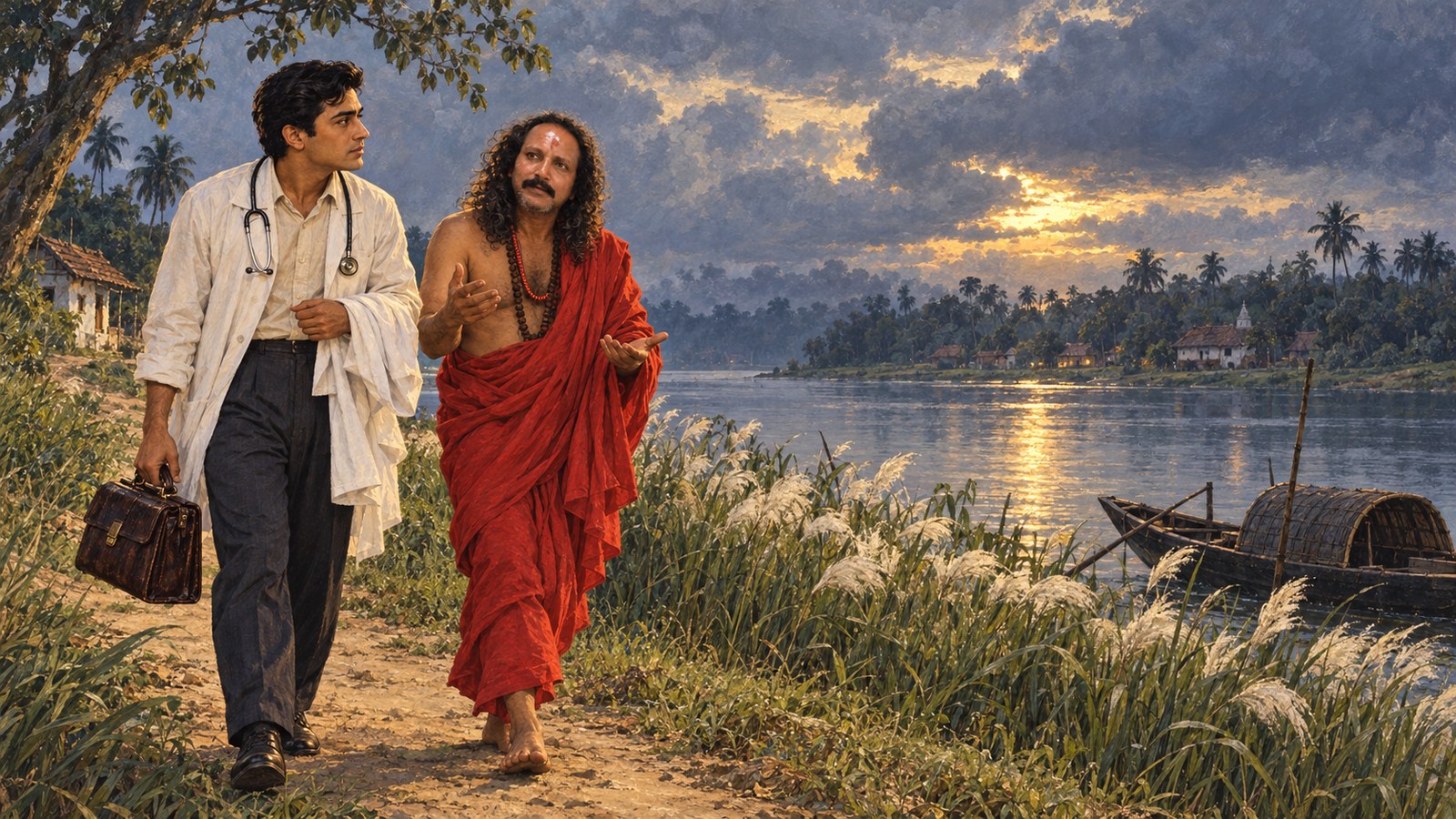
The man goes. Pagla Baba tells Shashwata to go with him in the morning; he will say where. Boudi: who is that man, Baba? Pagla Baba: our Shashwata’s room. Boudi: meaning Shashwata will live in a rented room? Pagla Baba: no, no — his workplace; there is no doctor there, so I thought people would have convenience, and Shashwata’s work would happen. What do you say, Shashwata? Shashwata: yes, Baba; whatever you understand as good. Pagla Baba: then you need not go tomorrow; I shall see alone. There you will take money only to meet the need of an ordinary life, not extra. Suman: when did you speak? You were here. Pagla Baba: why, when I went out in the morning, then I spoke. Now do doctoring here some days; then I shall take you somewhere else. Rama, you go home today. Satish, you go too. Shashwata and Suman will stay; they will do my cooking. Shashwata, learn; if you cannot, on this path everything must be known, otherwise no fruit. Shashwata: yes, I can these things; even if not good, I know cooking.
Printed page 55
Pagla Baba: then one work less to learn; the rest, if you do not run, you will learn. Amal, you set out; you have much road. Boudi: then Shashwata, you stay; we shall meet again. After pranam, Amal, Rama, Satish leave the kutir. Afternoon has only come. Guruji sits in a chair on the verandah; Suman and Shashwata sit on the floor. Suman: will you drink tea, Baba? Pagla Baba: you are a great addict; when your addiction presses, give me a little too. Suman: no, Baba, I do no addiction; I wanted to make tea for you. Pagla Baba: you do no addiction. Shashwata, have you any addiction? Shashwata: not so, Baba; I smoke a little, and in the morning a little tea. No other. I have lessened the smoking much. Pagla Baba: Suman, see, learn something from Shashwata. How he first did addiction, then judging the quality of addiction lessened it; and you neither did addiction nor got the power of judging. Shashwata, you are a doctor; addiction is bad for the body; then why do people do so much addiction? Shashwata: perhaps from the wish to know something, mixing in it, a person falls into addiction, and then body and mind become that. Pagla Baba: and so, I understand, people become drunk on the addiction of becoming human.
Printed page 56
Drunk on moha they wander and forget. A sense of their own power perhaps they load as another addiction on the head, and to cut that addiction— Suman: I shall say a word, Baba. Pagla Baba: you say many words. Suman: but Baba you smoke, and quite a lot. Pagla Baba: yes, I do; to mix with them one has to remain in addiction; if I stay I shall judge you again. I watch through the ugly smoke, flying smoke. Suman: then is doing addiction good, Baba? Pagla Baba: yes, good — yet that addiction whose only work is to know oneself, and to judge another’s quality, that addiction is good. Whatever is on this earth has kept us covered in addiction; to cut that covering one must do the addiction of waking oneself; and if one can wake, a way is found even to make nectar of poison; and in taking the taste of nectar there is only enjoyment. Do not drop sleep-and-such going to wake yourself; the more you shut the eyes to wake yourself, the more you will be able. Now give me the tea-addiction a little, then I shall give smoke again. When Suman has gone, Pagla Baba tells Shashwata: now you may take rice; at night roti, paratha; do a little meditation; rise early, bathe with stale mouth, in the mind pranam Surya, pranam the gods, take a pot of water under the bel tree and finish pranam.
Printed page 57
Shashwata: I shall do so; and when I have you in front I shall pranam you; I have already taken you as Guru. Pagla Baba: all right. Shashwata: may I ask a question? When will my diksha be — I mean, can I receive mantra-diksha like these people? Pagla Baba: without mantra-diksha this life of yours will be vain. I shall give you everything, and the duty of keeping and protecting it you yourself must take. The further you go on this path the more you must walk very carefully, crossing the traps of temptation. Without the Guru it cannot be protected. Your Guru is not this body of mine. This is only a medium. Your Guru has been through birth and birth, and making me the medium will teach you; and the day you yourself obtain guru-hood, that day you will merge together. The day of your diksha is already fixed; only Guruma’s blessing is needed; I have sent her word; in time she too will come. Taking only the Guru’s blessing will not do; Guru-shakti, Guruma — her blessing too is needed; with that you must go forward. Shashwata lies at the feet: Baba, give me shakti that I may spend my whole life as your servant. Pagla Baba, hand on Shashwata’s head: this endless — we are all. Again we are servants of shakti; on one side servant, on one side a part of meeting. The Guru does not want seva. The Guru (lifting Shashwata) wants meeting.
Printed page 58
Suman, teacup in hand: Baba, tea is ready. Pagla Baba turns: come, give the tea. He wets the throat. Sipping, he rises: you sit, I come a little — and goes out. Suman and Shashwata sit in the verandah. Shashwata is silent, looking at the sky, wanting the upadesha given here to mix; it seems this is Bhagavan in human form, getting whom so near, being able to touch his feet, life becomes blessed. Suman: brother, was there any word of your diksha? Shashwata, smiling: yes, Guruji said very quickly Guruma is coming, and with her blessing my journey on this path will begin. Suman: bah, well! Then a wonderful matter — you will begin your journey with the blessing of Guru and Guruma, and Guruma will be there, meaning on the day of diksha there will be very good cooking. Guruma cooks the eating with her own hands; that rare taste — I have eaten her cooking a few times and still cannot forget. Shashwata: you have eaten Guruma’s cooking many times? Suman: more or less two or three times; Guruma cooks bhog when there are large pujas; then all disciples present have been able to receive the taste. Shashwata: that bhog — what is Guruma like? Suman: she too — what kind of conduct?
Printed page 59
Shashwata: like our Gurudev. Suman, laughing: no, no, she is not like Pagla Baba. Our Pagla Baba does not even finish any word; so I understand his words a little less. Guruma explains the whole word well and always keeps us sheltered. Shashwata: in what matter does she keep you sheltered? Suman: you will not understand now; you have only just come new; stay some days, then you will understand. Is it for nothing everyone calls the man Pagla Baba. There is no fixedness at all; when he will do what, whom he will tell what. Sometimes he says bring water, I shall drink; the next moment when water is brought he says do not torment me, quench your own thirst, do not load it on me. Who is own, who is other, is very hard to know. Sometimes he keeps laughing much, sometimes in solitude thinking he even weeps. Seeing these forms you too will not want to stay alone with him; I do not want to stay alone at all; I have never spent time alone with him. And you saw — sometimes he says do addiction, sometimes do not; sometimes shut the eyes, sometimes stay awake; eat more, this is the age, after this you will not be able to eat; and when people come he says see how much the boy eats. Yet brother do not fear. He will not do with you now such things. Still we are with this Pagla Baba quite well; with both fears we pass the time in joy. If we do not see him many days the mind becomes somehow heavy.
Printed page 60
The day does not want to pass at all. There is a great pull toward our Baba. As people say, to go to see a tirtha-place the tirtha itself calls, and if it does not call one cannot go there. So our Pagla Baba, whoever has mixed once, he pulls again and again toward himself; a strange love, a hint of one’s own people, is found in his eyes. Shashwata: brother, do you remember the day of your diksha? What rules had to be kept? Suman: oh, many things. I do not remember much now; yet I had to stay empty-stomach the whole day from morning till afternoon; Gurudev and Guruma did much puja; I did not have to do it — only they did. I was quite afraid; this much I remember. And in which mantra whose diksha will be, he knows; and according to that what rule, he will say. Shashwata: then is everyone’s diksha not in one mantra? Suman: no, no; whom he gives what — in this line there are many; at which step he will give diksha. Shashwata: that he will say. One must go step by step. At which step was your diksha, brother? Suman: I have had abhisheka; meaning one step of abhisheka is done. Next, if he is gracious, a little further, shaktabhisheka. Shashwata: is that another step? Suman: yes, then again purnabhisheka after shaktabhisheka, then another kroma-step. When purnabhisheka is done, in this way the red cloth goes on.
Printed page 61
Shashwata: then it will take me many days to cross all this. Then I shall be able to wear red cloth like Pagla Baba. Suman: that is hard to say, how many days. If Pagla Baba thinks, he can even put you two or three steps forward. I feel he likes you; how beautifully he explains everything to you; you are a person known to him many days, otherwise he would not agree to give diksha seeing someone one or two days; he would spin them many days, come today, come tomorrow. Shashwata: you say right, brother; I feel he is very much my own, whom I can feel in my inner being. His voice, his form, his ways — all as if known to me many days; who has shown himself to me again and again and saved me again and again from danger, otherwise perhaps I would not even have lived. He knows all of me. That is why, understanding this danger, he himself as if brought me here. Yet it seems if I had met him still earlier it would have been much better. I would not have had to walk these thirty-two years of life with a load of untruth. Still I wish to thank the events that happened in life. Many memories of sorrow, after getting him, have floated into a sea of joy; sorrow cannot surround me today. Now I feel myself much lighter. You know, brother Suman, in these few days I have as if given birth to myself again. Now, leaving only walking and talking, I want to lie in his lap like a child. He will hold the hand and make me walk, and make speech flower in my mouth. You only bless that I may walk on his path.
Printed page 62
Shashwata speaks in bhava; the words can, and speaking his words he leans. Suman: I feel in you too, brother, you will be able; there is another kind of shakti. When you speak, the words have quite another deep bhava; with my little intellect I have understood this much. Meaning first a good human being, becoming a good sadhaka, then sadhaka. Hearing your talk it seems you are already a good human being; now only— Pagla Baba: what, Suman, are you a donkey? (entering the kutir as he speaks) Why, you are a human; you too have one head, two hands, two feet. Even if sometimes you use the two hands like feet, everyone still calls you human, not cow or donkey. Let it be; even if people call you human, before me you remain donkey-cow; in that much less duty is found, no? Suman: yes, yes, that is good; I have no sorrow in that. Pagla Baba: see, Shashwata — shame, disgust, three remaining, this is not that line; this chela of mine has understood. Now make arrangement to quiet the wolf of your belly, otherwise he will not leave even the mat in the house whole; he will make everything a mattress. On the day of your diksha, empty-stomach, Guru and Guruma — that is in the mind; from remaining empty-stomach a bucket of sweat was wrung from the cloth above; there was a jhar of thorns. It was Bhadra month. Suman: I, Baba, a porcupine? Pagla Baba: were you thinking yourself some walking animal among trees?
Printed page 63
Pagla Baba tells them to make luchi or paratha — not dry leftover roti — and alu-bhaja; he will see Shashwata’s quality of cooking. Suman’s tongue will want alur-dom; then let it be alur-dom. Suman must give a hand, otherwise Shashwata will not be able to pranam him. First finish the evening rite quickly, then help. Shashwata, watch what he does; do not try to understand anything; only look well. They wash, change cloth, pranam the Guru, enter the kutir. Pagla Baba, sitting in the verandah, has already begun manas-sandhya. Evening has only come; before dark thickens, stillness has come down on every side; a south wind races toward the kutir. Pagla Baba, two eyes shut, takes himself from one layer to another; slowly he is becoming empty of outer knowing; in manas-puja his outer kriya as if he has lost everything. He remains this way a good while.
Printed page 64
Sandhya-kriya finished, he begins to sound the shankha. Suman has taken the kriya in well; Shashwata too. They come out to pranam and complete their own evening rite. In the verandah Pagla Baba is still sitting, busy in unworldly kriya. They sit beside him; there is no courage to call or touch the body. After sitting longer Shashwata asks how long he will sit like this. Suman waves him silent, then once calls Baba. Pagla Baba sits eyes shut like stone. Stillness has increased. In the soundless dark the coming and going of wind grows; in the hard wind the great trees behave as if mad. Jackals and dogs sitting far off suddenly come near the verandah and sit silent. Wind touching the body feels like the touch of many. Both bodies begin to feel heavy. Suman and Shashwata sit a little closer, body to body. Some unknown fear wants to seize them. Pagla Baba as if has no heed at all. Suman’s call has not reached Baba’s ear. From inside the kutir a tick-tick of vessels as if changing their own places. Shashwata signs, takes Suman’s hand, and they enter together.
Printed page 65
In the lamp’s light everything is quite clearly seen; the sound’s meaning is not understood. The vessels are in their jammed places as they were. Suman lights the hurricane without a word. They pass the eyes well once more in that light. Nothing falls on the eye, yet the room is filled with a very beautiful scent. Suman signs Shashwata outside. Jackals sit around the bel tree; in the hurricane light their eyes glitter. They sit side by side against a verandah post. After a little, from inside the room someone calls, give water. Both keep the ear up. The word is right — someone is saying give water — yet neither dares rise. Suddenly the jackals rise together and make a terrible uludhwani. Shashwata clasps Suman. Suman, hus hus, standing in the verandah, tries from far to drive the jackals. Then quite loudly in the ear: O, who is there, give a little water. Shashwata and Suman enter together, who, who? What, you are here? O, give a little water, I have been saying so long; you seem not even to hear. Pagla Baba is sitting on the taktaposh swinging a foot. Shashwata dips a ghati in the bucket and gives water. Pagla Baba: O donkey, give it in a glass; do you understand nothing? — he says to Suman.
Printed page 66
Suman gives water glass by glass; Pagla Baba drinks two glasses and the thirst is not quenched. He signs Shashwata to pass the cigarette. Eyes shut he draws. Both stand silent. Shashwata wants to say something to Suman when from outside comes the sound of something falling with a jhapang. Shashwata turns to look; Pagla Baba stops him: wait. I had spoken of firewood; Budoka has brought wood. Suman, go set those in their place. Suman goes out; curiosity takes Shashwata out too. A man past sixty, lungi, bare-chested, has set down a sack. Wiping face and hands with a gamcha: where is your Baba? He told me to give fuel; I brought a little extra, because at night coming here again and again the skin crawls. Let me pranam him once, then you go a little way with me. Entering I saw some standing like shadows, so I will not delay — is Baba in the room? Shashwata: yes, come. Setting foot in the verandah, from the room Pagla Baba cries Ma, Ma, Ma-go Ma. All freeze outside the door, very astonished. Shashwata: what happened, brother? Suman: nothing — and grows a little courage.
Printed page 67
Budoka: today let it be; I shall rather finish pranam from outside. He seems a little busy inside. He lies in sashtanga in the verandah; seeing him Suman and Shashwata knock a pranam too. Come, Babas, see me a little across, otherwise I shall be late home. Pagla Baba from inside: give him a little water and batasa, and from here ghati-water and a flower from the Guru-patta in his hand. Budoka, getting Pagla Baba’s voice: shall I come in, Baba? I had a word. Pagla Baba: do not think; I have told them; the water they give, feed three times, and put that pillow-flower under today, then the danger will cut. Budoka: I had come to tell you all, yet what more shall I say? If you do not mind, one word, Baba? Today entering here I felt somehow afraid. The body was becoming cold. Some were looking and looking at me. So I thought, not today, tomorrow morning I shall come and talk again. Actually after feeding her three marks of medicine the khichuni will not lessen at all; there is quite a fever on the body. Pagla Baba: which doctor did you show? Budoka: doctor? Sisir-babu’s son; Sisir-babu is no more; his son now gives a little medicine.
Printed page 68
Though he did not pass, he has matric-passed and learned to read his father’s doctor-books well; so everyone in the village goes there. Stale food, a belly-illness. Pagla Baba looks toward the jungle-doll: what doctor is that, then? That is why the fever is not leaving. Toward Shashwata: that will be it; what else? Shashwata, astonished: I have not seen her. From what did her fever come? Yet when you say so, pressing the belly, that will be it; nothing else can be. Pagla Baba: listen, Budoka, this is Shashwata-babu, a passed doctor. He has come from Kolkata, a doctor of the big Kolkata hospitals; from now he will do doctoring here some days. Tomorrow morning show Putul to him once. Tonight’s arrangement will be done with these; no fear; and give him his fee according to your means; you need not give much money. Budoka, turning to Shashwata: so you are a passed doctor? You will treat in this village of ours? Then there will be much help. Here we have no such big doctor; poor people have no way to go to one. Shashwata: all is Baba’s wish; if by me some help of doctoring happens for you, then my passing will have become meaningful. Pagla Baba: tomorrow from our house’s ground you will find Shashwata; take Putul to Guptaji’s in the new bazaar.
Printed page 69
Budoka: the new bazaar? Then no trouble. Baba, when can he be found tomorrow? Pagla Baba: between ten and twelve; if patients increase he will go in the afternoon too. Budoka: all right; how shall I thank you; you are not an ordinary human being. A little foot-dust. Pagla Baba: that is all right; you need not put hand to the feet; pranam on the earth, and if you have a rupee with you, leave it with me; now go, you will be late. And those who were looking and looking at you today have now known you; they will not look and look; so the skin will not crawl. You will be able to go alone. Actually at this time they want a little sanga with me, so they keep a little too much eye on who came and who went. Go home. Budoka: all right Baba, I come now; only keep a little eye, Baba — and he goes out. Suman lifts the hurricane so Budoka can see a little path. Budoka: you go to your work, Baba; I have a torch; I can go; I have no more fear — and he goes on quickly. Pagla Baba comes out. Pagla Baba: Shashwata, tomorrow morning you will go with me. See your workplace; from tomorrow do doctoring there.
Printed page 70
In that perhaps some seva of these poor people can be done. Joy is found, and if in the seva of humans a last aim is on the sat-path, then being human one receives the puja of humans. Remaining on the sat-path one can build oneself much self-trust; and with that trust many impossibles are done without effort, because from sat, truth, and from truth the creation of sur. Where you are sat, there you are truth. And so you too are that sur. Where you are asat, there in a-yoga you are asura, whose place is a filled patal. There in the dark there is hope of getting much — which is a wanting of what cannot be seen. So its fullness does not come. Then people again in a-yoga become un-human. Below asakti, above shunya; the human remains, standing on a hanging rope in the middle, where if the weight of wanting increases it will tear and fall into patal, and if one can empty oneself one will mix in shunya. That is why the human is made of sur and asura. Waking, the thought of sur; all thirst will quench. The full jar will not want more, the toy of false happiness. Whose I am today, his I shall be; shunya is my thought. In all work Mother is mine — let that remain my thought. Pagla Baba, clapping, sings enchanted; Suman and Shashwata remain bound looking at him. What rare bhava. Now he sings.
Printed page 71
A child’s play in the Mother’s lap, all knots made a screen. Give, Mother, emptying, I float the boat, a raft of cloud. Let dawn’s light rise in the mind; I shall wake only saying Ma, Ma. Only with the Guru’s ashis, then, Mother, let death hold me. A stream of water runs from Shashwata’s two eyes. Suman, unable to hold himself, lies at Pagla Baba’s feet. Pagla Baba lifts Suman, clasps him, come, come, my come, holds him to the chest. Suman and Shashwata keep weeping without a break. Pagla Baba with the other hand pulls Shashwata too and says, you are very good, you have much bhava; only a little lack of work, which I shall give you. Then your play — I do not want Ram, I shall be Ravana. Take, now leave all this. What work there is, finish those, otherwise in the stupor of bhava everything will become error. Shashwata and Suman as said gather themselves and go forward to the work of cooking. Pagla Baba sits alone in the verandah; two dogs come up to him; he strokes their bodies; the two dogs sit on two sides as if guarding him. Suman arranges wood in the unun. In Shashwata’s mind many questions come and go; what happened this while, its actual meaning is perhaps hard to find. What is this that keeps happening; my dream, or true?
Printed page 72
Suman: brother Shashwata, begin your cooking; the wood in the unun has caught well. Shashwata, setting the karai, cannot make the sums of what he saw meet. Suman: is this your arithmetic, that these things should add? Seeing all this I was rather afraid; luckily you were there, otherwise what would have happened to me alone? Shashwata: you say right; staying alone with him is quite fearful, and again quite a joy. People run after miracles; we remain in the midst of them. Suman: no one will want to accept these experiences of ours. Yet the mystery of what is happening — one must catch Pagla Baba once to know how he can do these unbelievable works.
Printed page 73
Suman forgets Pagla Baba’s ear is a kilometre long. Pagla Baba sits looking at the sky, smiling, muttering, then calls Suman. Come, look at the sky — do you see? After a while Suman: Baba, nothing much is seen. Pagla Baba: why, do you not even see the stars? Look how far they are, yet with your eyes you see them clear; and between one star and another you see another, and the empty between two stars — what is that empty you see?
Printed page 74
Have you ever, taking time alone, tried to see those stars with the mind’s eye? You will see how near one can come to them, even feel a touch. We accept only what these two eyes see, and what the eyes cannot see we will not accept. That does not mean what is not seen does not happen. Much remains in this living world and walks around us that the bare eye does not catch. The unworldly is seen only with inner sight, and in that seeing one feels it in the inner being. Worldly sight only births the thought of difference and grows I-ness. So one must sometimes take oneself into a quiet and become alone, that one may speak only with the inner. Shashwata nods yes. Pagla Baba: that path is already given you; give a little time, japa, dhyana; from that kriya the answers will come of themselves, and the shakti stored will fight the worldly and take you toward the unworldly. On this path there is much fight — making oneself the opponent, defeating oneself, going forward as victor.
Printed page 75
Night has gone quite far. Shashwata’s luchi is ready. Suman wipes sweat; Pagla Baba teases that rain has begun on his head. Suman brings hot luchi and alur-dom as bhog. Pagla Baba sits: will you eat cold? Sit together with hot luchi; today we take together. Shashwata and Suman spread asanas and take the plate of luchi.
Printed page 76
Suman finds the salt too much; Pagla Baba takes a little from his own plate as prasad for both. Taking the Guru’s prasad with devotion they say the salt is now exactly right. Pagla Baba: that is why I say, throw a little on the earth and take; the earth will draw what should be drawn. Throw a little on the earth and put a little water there; you will see the salt mix in the water and all become right. Both do that kriya; then everything as if becomes right.
Printed page 77
Shashwata lights a cigarette: brother, how was the cooking? Suman: did you not see Pagla Baba say, and his eyes flash of themselves? Shashwata, smiling: actually whatever is to be done, he does; whatever was less or more became right in his sleight. Suman: what sleight? Do you mean throwing on the earth and eating was not for nothing? Does something happen in the earth? Shashwata: I do not think so. Eating and eating, sometimes food falls on the earth; has the taste of cooking ever changed from that? Not in my days. Suman: you say right; I had not thought so far; that was his sleight; that is why he did not let more talk, lest I ask something. Shashwata: yet he hears all.
Printed page 78
There is no gain in thinking these things. Budoka’s event, Putul’s fever, is troubling Shashwata. He wishes even now to see Putul; from what the disease came he as a doctor fidgets. Pagla Baba said stale food — then nothing else. Yet he wishes to press the pulse and belly. Suman: when did Pagla Baba go into the room? Did you see? Shashwata: no, he was sitting in the verandah like stone. When the jackals cried I turned my eyes; before that I was looking at him.
Printed page 79
If there are two, then where did one go? Which is real, which a ghost? After the whole evening, you frighten me again. I had thought we must pass the night here; I did not give that thought much force. Better discuss in the morning light. Say some other good words. Shashwata: why would he become a ghost? You heard — he told Budoka the ghosts stay outside who come to speak with him, and they keep watch. The night before I too felt something; yet with Dada-Boudi the night passed somehow.
Printed page 80
Will understanding bring sleep? The eyes are somehow — do you not hear a sar-sar sound? Shashwata: I do not know, and I do not want to hear. Pagla Baba said they have known Budoka. Then they have known us well too, from before. They have heard we must rise early. If they rest we can sleep in peace; they have surely heard this talk of mine too. The sentence is not finished when from the bel tree something falls to the earth with a jhapang. Shashwata turns, starts — what is this? A severed head toward us.
Printed page 81
A human throat-voice seems to call, striking. Shashwata: brother, listen — someone is speaking, do you hear? Suman pricks the ear: yes I hear. What time is it? In the dark the watch is not well seen; Suman lifts the hurricane: four-fifteen — dawn has come. Pagla Baba is doing pratah-kritya; that is his throat. Shashwata: dawn has come; we do not understand when we slept. A little light is breaking; dark has not yet cut. Now perhaps we must rise.
Printed page 82
Pagla Baba: here, Shashwata, your tea. Shashwata takes the cup: Baba, you might have woken me; I would have made tea. Pagla Baba: all right, drink; perhaps in the night sleep was not good. He goes inside. Suman: after what happened at night, how will sleep be good? You were saying something — whose severed head was rolling. Shashwata: yes, I thought a severed head was rolling this way; I was very afraid. Suman: this must be told to Pagla Baba; this is not right; how will people stay here? Shashwata rises to see what it actually was.
Printed page 83
If you go home today I shall be in much trouble staying alone; that is not mouth-talk. Suman: you will be very afraid again staying alone. Pagla Baba comes out: Shashwata, finish what work you have; in a little you will go out with me. I come now, then I take you. Suman, if you want to go home you may; yet see, they have known you well and have come to love you much; they were telling me of you, that you have much courage. The others all fear them; so they want to stay with you, and if you go anywhere they will want to go with you. Last night’s severed head—
Printed page 84
Suman: but Baba I do not love these things much; tell them not to come to me. Pagla Baba: you tell them; I do not want to stay between you; you understand your own loving. I come now; think and let me know what you will do. Suman: I am not yet so strong that I shall walk with them. Please make them understand I cannot now; from fear of them I wanted to go home, and now they say they will go with me — no, Baba, I am very afraid; please drive them. Pagla Baba: so you fear them; now I understand, perhaps that fear of yours has pleased them. All right, I shall see what can be done. Yet do one work: stay here some days now. If you go somewhere again they may go with you.
Printed page 85
I did not even believe these things before; now what I see, all my knowing is becoming untrue. Shashwata from childhood in an utterly remote house has seen such things. How many neighbouring wives were seized by ghosts; remembering that experience the bone still goes cold. The wives’ eyes and faces would change; looking at the face one was very afraid; they would sit with hair loose shaking the head hard; the two eyes as if rose to the brow; the throat-voice changed like boys’; if anyone came in front they would rush as if to tear and eat. The village had great ojhas; bringing an ojha, the ojha with a jhanta—
Printed page 86
Shashwata finishes snana, walks the path the Guru taught — Surya-pranam, water at the bel-root, pranam to Guru and gods in the mind — and sits in the verandah. Suman sits with a bowl of muri. They eat muri and coconut. Then three people, very hurried, cross the small gate — two men and a woman. The woman, much agitated: is the sadhu-baba here now? Suman: who are you? Baba is not here now; he has gone out a little. Woman: we need the sadhu-baba terribly; we are in great danger; hearing his name on people’s mouths we have come.
Printed page 87
Come with us once, otherwise what shall we do? Perhaps she cannot be saved. Suman: no, we cannot; we are not ojhas, and our Baba does not do this kind of work. Go somewhere else, to some ojha. The woman lies at Shashwata’s feet: have pity, sadhu-baba, come with us; I know you will be able. Shashwata starts, lifts her. Then Pagla Baba enters: yes, she says right — you will be able. All look at Pagla Baba. The woman: yes Baba, you say right; make him understand so that he goes with us. Seeing him I have understood; he will be able to save us from this danger. Shashwata and Suman look astonished at Pagla Baba.
Printed page 88
Shashwata: but Baba I am not — I know doctoring and nothing of that. Pagla Baba: have you not heard ojhas’ stories — haritaki-burnt, turmeric-burnt, a little water sprinkled, the same; you too dress as an ojha, act a little, then do doctoring, and you will see all become right. The patient will become well and people’s help will happen. Why there one must do so, dressing in a false jnana, the disease can be freed — understand. Shashwata: yes Baba I have understood. Then shall I take them? Pagla Baba: no, take only the ghati; take water from there, otherwise a ghost will truly come present. Outside they wait. He marks Shashwata’s brow with red sindur; Shashwata is much agitated.
Printed page 89
Suman: Baba, what will Shashwata do there? I heard a ghost has seized; I did not understand. Did you take him in and teach some mantra of driving ghosts? Pagla Baba: yes, see, giving mantra in the ear he became somehow stirring; Shashwata’s self-trust grew. His face too somehow changed. Coming out without any fear he told them, come, where must we go. Yet I think he should have written the mantras. Such terrible work, driving ghosts; if the mantras are forgotten, harm will be Shashwata’s. Pagla Baba: you have said right; if he had a buddhi like yours he would have written all the mantras. Perhaps my error; sending you might have been better. Let it be; no gain in thinking now.
Printed page 90
Suman: what risk, Baba? Pagla Baba: nothing much — take this, you woke the ghost inside you, let it walk as your own satan, and getting its freedom it will scratch itself a little, pull and tear the hair of its own head. If it goes too far you yourself must drive that ghost with that mantra-water; if it goes a little this way or that, trouble — that ghost will drive you and remain occupying your body. Understand, this is all. Suman: yes Baba I understood; yet let some more days pass; increase the diksha a little, then I shall learn. Pagla Baba: then let it be now; when you wish again, say, I shall teach. Now give me the puja-jogar. Suman goes to give the jogar. Meanwhile Shashwata—
Printed page 91
The family: come Baba, the girl is in the upper room — they show the stair. Shashwata goes up into a hall; on the left a closed door, the girl’s room; her father is in that room with her. Shashwata: wait a little. He sees another closed room in front. Mother: no one is there, Baba; do you want to see? Shashwata: yes, open it. Entering, a damp smell comes to his nose. A clean room, not much furniture, a large bed, a sheet stretched beautiful.
Printed page 92
He rises quickly and comes out without looking any other way, a little agitated. Mother: shall I open that room’s door now? Shashwata, hardening the mind, holds out the ghati: fill water. She fills it. Now open the door. He enters; in front the bed; the girl lies eyes shut, fifteen or sixteen; her father sits at the head. Shashwata without a word goes near, looks well; on eye and face quite the look of illness; the body has taken much strain. Taking the girl’s pulse to examine, the girl breaks, and seeing Shashwata cries this, this. He takes her hand.
Printed page 93
Shashwata thinks: Pagla Baba had said a ghost does not seize like this. What the girl is doing and saying is indeed like a ghost-seizure. Then the girl, gathering herself a little, takes a last ugra form, jerks her father away; seeing that form all, with the father, flee the room in fear. The girl now runs, rushing at Shashwata. Suddenly the Guru’s word floats in the ear: a ghost does not seize this way. Shashwata now, saying the Jai-Guru mantra, presses hard with his thumb on the girl’s brow; the girl falls on the bed and at once becomes altogether quiet. Saying Jai-Guru in the mind he strokes her head; she lies eyes shut like a tired child. Quickly he takes a sleeping medicine from the waist.
Printed page 94
What she had felt, she had mentally loaded her own sister inside herself, so she was behaving so. The sentence not finished, all lie at Shashwata’s feet crying Jai sadhu-baba; you are not human, you are certainly Bhagavan. Shashwata himself is astonished at himself: what am I saying? I know nothing. Gathering himself, saying Jai-Guru, he pulls them up: now I come, my work is finished; take her to hospital and admit her now, otherwise there will be danger. Father: then that room? Shashwata: keep the room shut now. First the hospital, then come once to our kutir; what must be done can be said then. Your dakshina you will give at the kutir; now let me go.
Printed page 95
Shashwata returns. Pagla Baba, eyes shut, takes a little naivedya-prasad from Suman’s finished puja. Suman: Baba, when Shashwata went it is hard to say when he will return. Pagla Baba: so he had to go; yet he will return now, I think. Are you thinking for him about driving ghosts? No, not so; when you have taught him mantra he will be. Then a car comes before the kutir; Shashwata gets down, enters quickly, pranams sashtanga. Pagla Baba: you have returned, you delayed much; take prasad. A little water quickly; now again you may have to go out — Budoka perhaps with Putul. Sit.
Printed page 96
Leaving the kutir Shashwata follows Pagla Baba on the road; Pagla Baba seeing him walks on long steps. At the three-road corner Pagla Baba: listen Shashwata, take this right road, leave two shops, a little on you will find on the right a signboard written doctor-khana; Budoka is standing there, and that is the workplace. Go now; I have other work; talk with me later — and he goes straight on. As said Shashwata takes the right path and sees Budoka standing before the doctor-khana board. Budoka: come, doctor-babu.
Printed page 97
Guptaji has already shown Guruji the place this morning; he himself looked well. Shashwata sits: where is your Putul? Did you have to wait long? I was a little late from other work. Budoka: no, I came just now; your Guruji sent word in the morning that you would be a little late today. Shashwata, astonished: so, when did he send you word? Budoka: very early — say six-thirty to seven. Shashwata smiles a little: he had let it be known before. Budoka: why, did he not tell you anything? Shashwata only nods and smiles a little.
Printed page 98
Putul, after the three sips of the water Baba had said, vomited much in the night, then slept altogether; in the morning she rose as before, stirring, hungry. They have brought her only on dry muri from fear. Shashwata examines: the belly-pain does not seem; all is right. After returning from there yesterday the khichuni, fever, yet after feeding the water three times the body threw it out. Shashwata will see what to give now.
Printed page 99
Shashwata: not much — only a little fever-medicine. Guptaji too has a few days’ trouble of digestion; Shashwata examines him well and writes medicine; if eating and drinking are kept to a little rule it will be right; nothing large, it seems. Guptaji: how much fee must I give? Shashwata: that is upon you; whose means as they are, I have set my fee so. Guptaji: I saw your Guruji too, and seeing you I think Bengali-babu; yet your Hindi-speaking is quite good. Shashwata: yes, actually we wander many places, so Hindi.
Printed page 100
Guptaji’s family all have a Guruji; theirs is not a tantric who eats fish and meat, a very shuddha man, takes only niramis, much love for jiva, large ashrams, many disciples. Gerua cloth, great jata on the head, body-colour like milk, two eyes a kind of blue glow, and speech — he says no word but Ram-nam. Shashwata: bah, in your description I have as if taken his darshan here. But Guptaji, knowing we are tantric you still let us sit in your house? Guptaji: what of it; here I have many shop-rooms, all my rentals.
Printed page 101
Seeing you I feel very bad; you are a doctor yet staying in that kutir you take so much trouble. Will you go once with me to my Guruji? You are an educated man; seeing my Guruji once you would understand what a Guru is; telling him you will see all your problems somehow solved — house, car, all you will get. Shashwata: so, such things happen? Guptaji, smiling a little: they happen, meaning, I say; how much more happens; how many people I saw, how many problems they had. Take me: business was all very dull, then I went to Guruji and going to him slowly all became right. See this tabiz he has made me; its name is dhanaja-tabiz, which increases wealth; it stays always at my throat.
Printed page 102
Shashwata: what I heard from you of your Guruji — I have never seen one like him. And ours speaks quite a lot. If you go to tell your own problem he begins to tell one person’s problem, and says look, the beggars sitting all day before the mandir doing Harinam — still Hari has not once turned to look at them; rather you are better, in a whole day you took Harinam twice or not; Hari gave you house and home; two more nam and perhaps he would have taken you in his lap — saying that he drives you and hears nothing more. Guptaji: what is this; a Guru will hear his disciples’ problems with mind and solve them. How else will disciples progress? Shashwata: yes, so.
Printed page 103
Guptaji remains only astonished looking at Shashwata. Shashwata leaves him and goes. Pagla Baba, back at the kutir, tells Suman to fry fish — look, for you I brought a live katla; you love katla-fry and khichuri, so I took a large fish; yet fry your share without salt; at eating throw the fish a little on the earth and eat; the salt you left on the earth yesterday you will get again, understand, because what you give here you will take back. On mine put a little salt, turmeric, all. Shashwata returns then, pranams at once: Baba, the doctor-khana is quite good.
Printed page 104
Pagla Baba: no, you again why? Whether you put salt or turmeric, you understand eating well; leave it to Shashwata; he has had much strain; he will make the fish-jhal in his way. You only wash the fish a little. Suman: but Baba I have cooked the khichuri. Pagla Baba: oh, the khichuri is cooked. Then put the fish on him; he has done nothing; he will only cook and eat. Who cooks also binds the hair; leave it all to him. Shashwata: yes brother, give it to me, I shall do these. Suman: Baba said today he had much strain; let him sit a little, I shall do it. Pagla Baba: how much of your daya — if you could give me a little you could become much lighter. No, rather you rest a little, otherwise again daya—
Printed page 105
You went to drive a ghost; whether you could drive it or not you still do not know. Shashwata: actually whether the ghost went or came I still cannot understand. What happened before, let me gather a little myself, then I shall say. Suman: gather again? Your event, you will gather. Shashwata: no, Pagla Baba will gather; all of mine has become pell-mell. Suman: have you forgotten the mantras? Shashwata: mantra? What mantra? Nothing sits in my head. Suman: this is the fear I was having — are you all right, brother? Does the body feel heavy? If there is any trouble, tell; you are very courageous; if you press it down there will be danger. Shashwata: uf, no brother, I have no trouble. Now stop a little; first let me cook, otherwise again like yesterday the salt will fall twice.
Printed page 106
Suman is frying; Pagla Baba comes. Suman: no Baba, not alu-bhaja; you said to make fish-jhal, so Shashwata fried the fish and made jhal. Pagla Baba: oh, you gave Shashwata the cooking? You did not let the boy sit a little? See how much delay remains. Shashwata comes out: no Baba, no delay, cooking is done. Shall I spread your asana? Pagla Baba: yes, put me inside the room, and you sit in the verandah.
Printed page 107
If you forget the mantras the ghost itself will sit upon you. You have not forgotten them? All is right? Shashwata thinks: oh, now I have understood why Suman was speaking of mantras, and wanting to know how I am. At once turning to Suman: no brother, I had kept all in mind, that is why I returned well. Pagla Baba: Suman, what, will you not want to know what ghost Shashwata saw? How the ghosts’ teeth were, how large the nails — know all. Suman: yes brother, tell; from when I have been sitting saying I shall hear all. What did you see, what happened there, what did you do? Pagla Baba: wait, wait, first let us sit well; then we shall hear it all gathered. Shashwata, you too sit beside Suman, and gathered tell the events. Shashwata: yes Baba I am telling. The house was quite large. There were quite some people. Entering the room—